
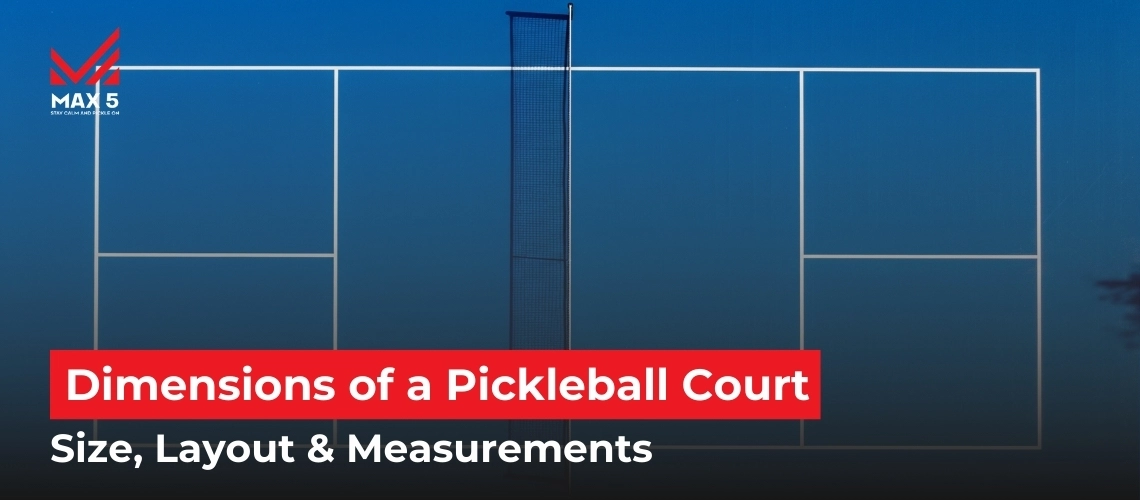
Dimensions of a Pickleball Court: Size, Layout & Measurements
You are standing in an empty driveway, sports court, concrete, basketball, or tennis court, holding a paddle in your hand, and wondering what the size of the pickleball court is. Trust me, you are not alone who is asking this question. According to the latest search from APP, nearly 50 million American adults have played pickleball in the last 12 months. Understanding the dimensions of a pickleball court has become a must-know information.
Knowing the official pickleball court dimensions helps you play by the rules, avoid common mistakes, and even convert other spaces like a tennis court for pickleball fun.
Official Pickleball Court Dimension:
According to USAP Pickleball Guide, the official governing body for the sport, a regulation pickleball court measures 20 feet wide and 44 feet (13.41 m) long, and this size remains the same for both singles and doubles play.
Here’s what you need to know:
- Court Length: 44ft
- Court Width: 20ft
- Net Height: 36 inches tall and 34 inches in the center
- Playing surface of the pickleball: 30 ft x 60 ft
- Ideal recommended playing space: 34ft x 64ft
- Non-volley zone (Kitchen): 7ft each side of the net and 20ft width
- Left service area: 10ft x 15ft each
- Court from corner to corner: ~48.33 ft
The regulation pickleball court dimensions create a playing area that’s roughly one-quarter the size of a tennis court.
Pickleball Court Size in Feet
Exactly 44 ft from baseline to baseline, and the wide pickleball court is 20 ft across. This creates a pickleball court square footage of 880 sq ft (44×20).
But you need more information than just the playing lines. US Pickleball recommends 8 ft of clear space behind each baseline and 5 ft beyond the sidelines. That brings your total recommendation space to 30×60 ft (1800 sq ft)
Regulation Pickleball Court Dimension
The regulation pickleball court dimensions divide the court into several key areas:
- Baseline to non-volley zone: 15ft
- Non-volley zone (Kitchen): 7ft
- Service Court: 15 ft x 10 ft each
- Centerline: Split the court into left and right service areas
Understanding these zones helps your positioning. The length of a pickleball court feels shorter than it is because the kitchen dimensions in pickleball rules force you to play farther forward.
Pickleball Court Lines and Markings:
Understanding the pickleball court lines dimensions is crucial for both players and court builders. Every line serves a specific purpose and must meet exact specifications.
Standard Line Specifications
All lines on a pickleball court should be 2 inches wide and preferably in a contrasting color to the playing surface, typically white. According to USA Pickleball regulations, court measurements are made to the outside of the perimeter and non-volley zone lines, meaning the lines are considered “in” during play. If the ball touches any part of a line, it’s a good shot.
Court Lines and Measurements
- Baseline: 20 feet wide, marking the back boundary of each court half
- Sidelines: 44 feet long, defining the outer edges of the court
- Centerline: Runs from the non-volley zone line to the baseline, dividing the two service courts (10 feet from each sideline)
- Non-Volley Zone Line (Kitchen Line): Located 7 feet from the net on each side, this critical line defines where players cannot volley
Kitchen Dimensions and Rules
The kitchen (non-volley zone) is one of the most important and unique aspects of a pickleball court.
- Kitchen Depth: 7 ft from net toward each baseline. That makes the total length of both kitchens 14 ft (7 ft per side).
- Kitchen Width: Same as court width, 20 ft (6.10 m) across sidelines.
If you want to know what the kitchen is in pickleball and why it matters for you game, then take Max 5’s expert guide on it.
Why the Kitchen Matters in Pickleball Game
- No volleying allowed: To volley (hit the ball mid-air without bounce), you must stand behind the kitchen line and ensure both feet remain outside (or behind) the line. Touching the line counts as being in the kitchen.
- Strategy: The kitchen zone forces players to rely on controlled shots (dinks, drop shots) rather than aggressive smashes at the net, increasing tactical depth and fairness, especially for beginners.
Tip from MAX 5: When you’re playing in the kitchen, you need control, not power. That’s where gear like the Max5 Vintage MX-0.1 Carbon Paddle shines. Its 16mm polypropylene honeycomb core gives you the soft touch needed for those tight kitchen dinks, while the raw T700 carbon fiber surface adds spin to drop shots. The 7.8 oz weight lets you react quickly across that 20-foot width without fatigue.
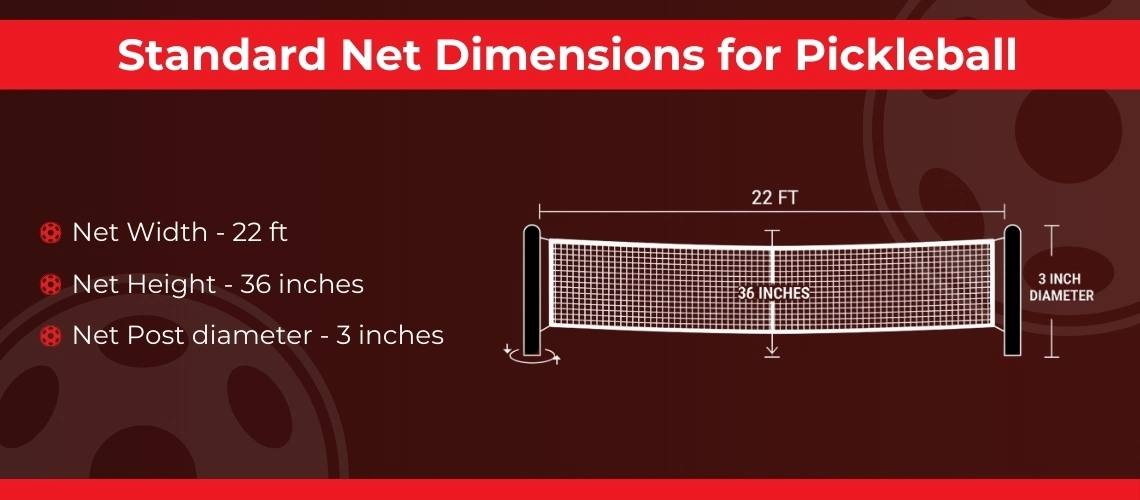
Standard Net Dimensions for Pickleball
A regulation net setup is as crucial as the court size. According to the rules:
- Net Width: Approximately 22 ft, the net spans slightly beyond the sidelines so that posts can sit outside the court.
- Net Height: 36 inches (91.44 cm) at the sidelines (posts), dipping to 34 inches (86.36 cm) at the center. This slight center drop provides a consistent bounce trajectory across the court.
- Net post diameter: Maximum 3 inches
Proper net height ensures fair play and compliance with tournament regulations, according to Pickle Pedia.
Paddle Tek Pickleball shows that pickleball net dimensions differ significantly from tennis nets, which stand 42 inches at the posts. You cannot use a tennis net without adjustment—those extra 6 inches completely change gameplay.
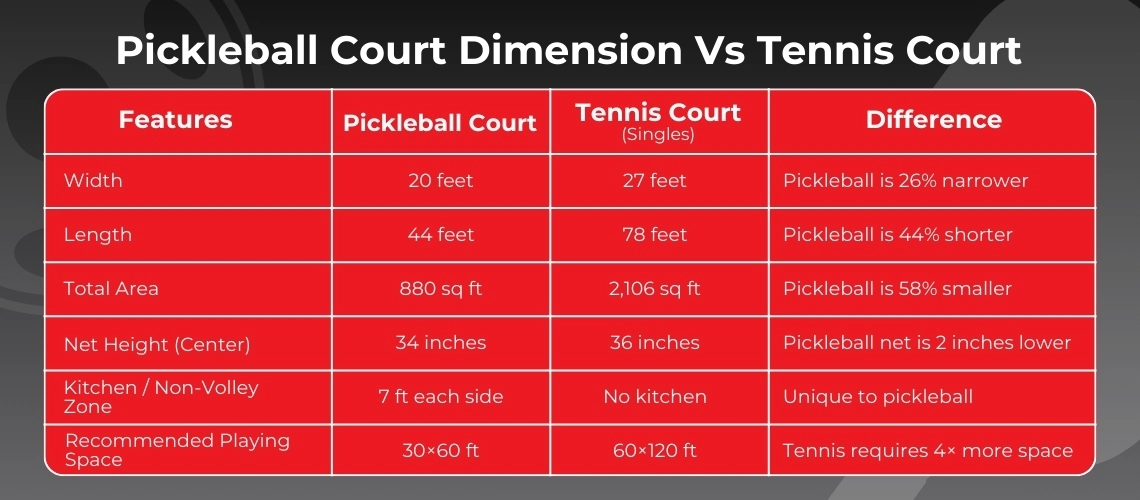
Pickleball Court Dimension Vs Tennis Court:
This is where space planning gets interesting. How many pickleball courts fit on a tennis court? Four for casual play, two for tournaments.
Direct Comparison
Feature | Pickleball | Tennis Singles | Difference |
Width | 20 feet | 27 feet | 26% smaller |
Length | 44 feet | 78 feet | 44% smaller |
Area | 880 sq ft | 2,106 sq ft | 58% smaller |
You can paint pickleball dimensions on a tennis court by adding lines for four courts inside the tennis boundaries. Or convert one tennis court into two permanent pickleball courts.
For players switching sports, the smaller pickleball court size vs the tennis court means less running but faster hands. Check out our blog “Is Pickleball Easier Than Tennis?” for a deeper dive on how these spatial differences affect your game.
Key Insights for Serious Players
- Overrun Space: 30 × 60 ft minimum; 40 × 64 ft for tournaments. Only 2 tournament courts fit on a tennis court.
- Surface Impact: Rough concrete → slower/high bounce; smooth asphalt → faster/lower bounce.
- Lighting: Poles 20 ft high, 5 ft outside court to avoid shadows and glare.
- Wheelchair Play: Court 44 × 24 ft; kitchen 8 ft.
- Orientation: North-south courts reduce sun; crosswinds may lower net by 2 inches.
How You Could Lay Out a Backyard Court
Let’s say you have a backyard or open space you want to convert into a pickleball court. Here’s a step-by-step outline:
- Clear a rectangle of 30 ft × 60 ft (minimum) or ideally 34 ft × 64 ft.
- Paint or mark the main court (20 ft × 44 ft).
- Add kitchen line 7 ft from where the net will go, spanning the 20-ft width.
- Draw the centerline to create service boxes (10 ft wide × 15 ft deep).
- Install a net that is 22 ft wide, 36 in high at posts, and 34 in at the center.
- Ensure line markings are 2 inches wide and clearly visible (contrasting paint).
Common Court Dimension Mistakes
Every experienced player gets these wrong:
- Net Height: Don’t set the center at 36 inches; that’s too high. Keep it 34 inches.
- Line Width: Don’t go bigger than 2 inches. Wider lines shrink your playing area.
- Overrun Space: Never skip the extra space behind the baseline. You need at least 10 feet for safety.
- Kitchen Depth: Don’t measure from the posts; measure 7 feet from the net.
- Surface Slope: Keep the slope under 1%. Anything steeper will affect gameplay and drainage.
Conclusion:
Knowing the dimensions of a pickleball court helps you play smarter. That compact 20 × 44-foot space is why pickleball is America’s fastest-growing sport. The 7-foot kitchen forces finesse. The 34-inch net rewards placement.
Whether you’re painting lines in your driveway or competing at a regulation pickleball court, these measurements create fair, consistent play everywhere. Pair that knowledge with Max5’s USAPA-approved paddles and balls, and you’re not just playing, you’re controlling every inch of the court.
Ready to own the official pickleball court dimensions? Gear up with Max5 and make every shot count.
Disclaimer:
This content is for informational purposes on pickleball court dimensions. Always follow official USA Pickleball rules for regulation play. Court setup, safety space, and measurements may vary by location.