
What Is Stacking in Pickleball? How It Works and When to Use
Have you ever watched advanced doubles matches and noticed players standing on the same side of the pickleball court before a serve? You have witnessed stacking in pickleball. But what is stacking in pickleball, exactly? It’s a strategic positioning technique where both partners align on one side of the centerline during the serve or return, then shift into their preferred positions after the ball is in play.
Unlike traditional formations where players occupy fixed left and right positions, stacking pickleball strategies let you maximize your team’s strengths, whether that’s keeping a powerful forehand in the middle or protecting a weaker backhand. The PPA Tour reports that professional mixed doubles teams now use some form of stacking, making it essential knowledge for competitive players.
What Is Stacking in Pickleball
Stacking in pickleball is a strategic positioning technique used by doubles teams where both players line up on the same side of the court before a serve or return. After the ball is struck, players quickly shift to their preferred sides, allowing them to maximize their strengths throughout the entire match rather than rotating sides after every point.
This doubles strategy has become essential at the competitive levels because it solves a fundamental challenge. Traditional positioning forces players to alternate sides based on score, often placing them in uncomfortable positions.
According to Pickleball Organization, stacking helps teams maintain ideal positioning throughout the game, even after serving or receiving, which is particularly effective when one player has a dominant forehand or when teams feature a left-handed and right-handed combination.
Types of Stacking in Pickleball To Distinguish
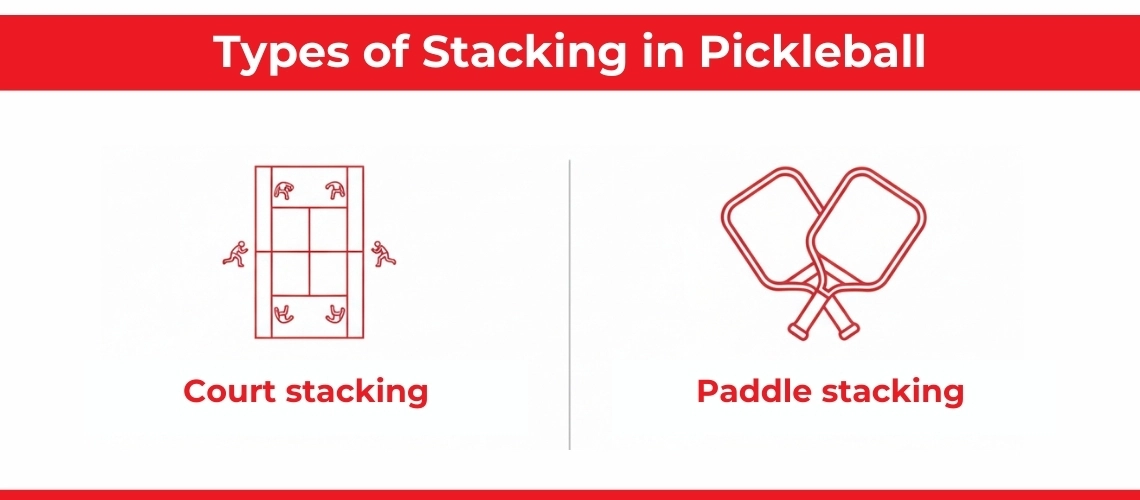
It’s crucial to distinguish between two common terms that often cause confusion:
- Court stacking
- Paddle stacking
Court Stacking (Strategic Stacking): This is the in-game, strategic positioning strategy used during doubles matches to maintain preferred court sides and gain a competitive advantage
Paddle Stacking (Open Play Stacking): This is an organizational system used in recreational open play, where players place their paddles in a queue to determine the order of play, commonly explained by community clubs.
How Does Stacking Work in Pickleball: Full and Half Stacking
Stacking in pickleball works by temporarily positioning both players on the same side of the court, then moving to optimal locations after the serve or return. This ensures each player ends up in their most effective spot, regardless of score or serving rotation.
- Full stacking means both partners start on the same side for both serving and returning. Partial stacking applies only to serves or only to returns.
- Half stacking means only stacking on serves to simplify positioning, often to keep a less mobile player on their preferred side or avoid complexity when receiving.
Step-By-Step Positioning:
When using stacking in pickleball, the first thing to understand is the positions.
For Example:
Player A (right-handed) wants to stay on the left side to hit forehands down the middle. Player B will handle the right side.
- Start Position: Both players begin on the same side of the court, left or right, which depends on who is serving or receiving.
- Decide preferred sides: Before the point, agree who plays left and who plays right based on strengths.
- Even Score (0, 2, 4, 6, 8, 10): The server must serve from the right side. After the serve, players quickly move into their preferred stacking positions.
- Odd Score (1, 3, 5, 7, 9): The server must stand on the left service box. Both players align on the left side of the court in a stacked formation
- Pre-serve alignment: The server stands near the baseline in the correct service box. The partner stands slightly behind, beside, or just inside the court near the NVZ line to allow space for movement.
- The serve: The server hit the serve from the correct side based on the score. Once the ball is struck, all positional requirements are satisfied.
- Partner movement: Immediately after the serve, both players cross and shift. Player A moves to the left side and Player B moves to the right side
- Post-serve formation: The team settles into their preferred stacked positions. Player A controls the left side while Player B protects the right side. Play continues normally with drinks, drop, and volleys.
Stacking Rules in Pickleball
Stacking is legal in pickleball as long as the correct player serves or returns from the correct court side based on a score.
According to the USA Pickleball Official Rulebook, stacking is fully permitted as long as the correct player serves or receives from the proper court side. You can’t move until the ball is struck, any premature shift could result in a penalty.
Key rules include:
- Server must start in the right service court for even scores, left for odd.
- Receivers follow similar parity but can have their partner positioned anywhere on their side, even off-court initially.
- No restrictions on post-hit movement, but maintain court awareness to avoid collisions.
Why Players Use Stacking
Stacking is popular because it helps teams:
- Control the middle of the court
- Reduce weak backhand shots
- Improve shot selection
- Play to individual strengths
- Gain better offensive positioning
Left-handed players, in particular, benefit greatly from stacking because it allows two forehands in the middle—one of the biggest advantages in doubles play.
When Should You Use Stacking?
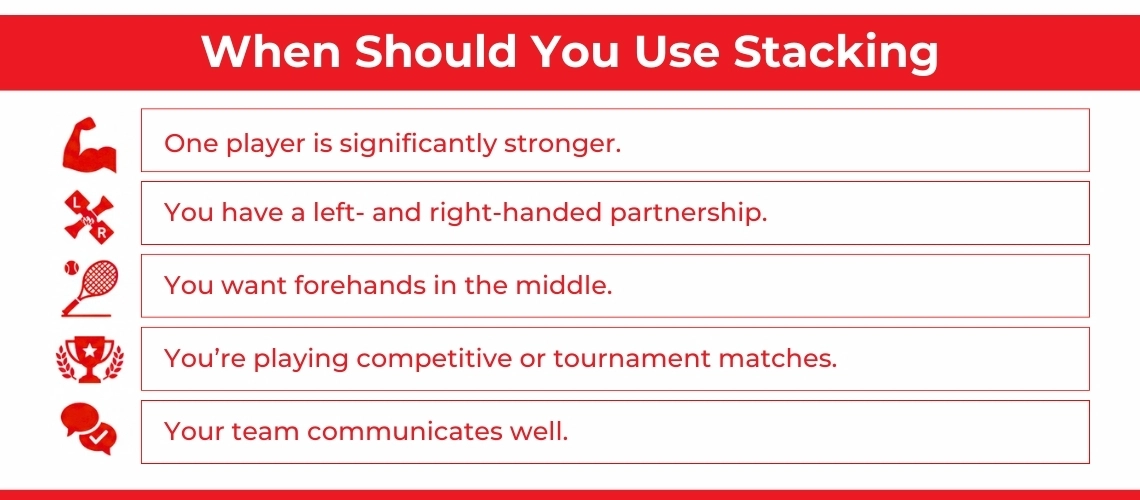
Stacking works best when:
- One player is significantly stronger
- You have a left- and right-handed partnership
- You want forehands in the middle
- You’re playing competitive or tournament matches
- Your team communicates well
For beginners, it’s best to practice stacking first before using it in matches, as poor positioning can lead to confusion and lost points.
Tips for Effective Stacking
Communication Is Non-Negotiable
- Call “stack” before serve
- Confirm server number every rally
When to Switch from Traditional Play
- Against aggressive middle hitters
- When one partner has a dominant forehand
- During tight tournament matches.
Practice Drills.
- Shadow stacking (no ball).
- Serve-and-switch drills.
- Two-ball transition footwork.
Stacking is a key doubles strategy that helps partners cover the court efficiently. Learn more about how to play pickleball with 4 players to apply stacking effectively in your games.
Common Mistakes in Stacking and How to Avoid Them
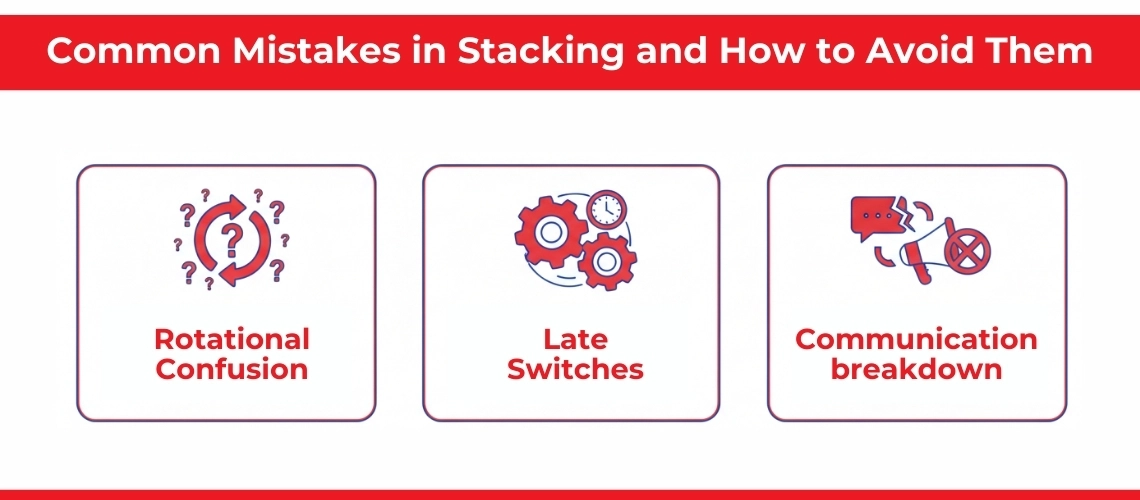
- Rotational Confusion: Players often rotate incorrectly, leaving gaps in coverage. Practice with your partner to internalize movement patterns.
- Late Switches: Shifting to your preferred side too late can expose the court. Move immediately after the serve for smooth positioning.
- Communication breakdown: Failing to signal or call intended movements causes overlap. Use short calls or hand signals to coordinate effectively.
Some common hand signals that people use are given below:
- First one is palm with all five fingers open, this typically signs to your partner, let’s switch or let’s stack, meaning unwinding the suck.
- The next one is your fist completely closed, which means stay.
- One more hand signal and it varies but typically, you have seen a finger wiggle. It means a fake switch. You pretend to unwind the stack, signaling a switch, but remain in your original position instead.
- Illegal position: Serving or returning from the wrong side violates rotation rules. Always check your starting positions according to the score.
Tip from MAX5: Enhancing control is vital. Using a paddle with superior spin, like the Max5 Vintage MX-0.1 Carbon Pickleball Paddle featuring a raw T700 carbon fiber surface for textured matte grip, helps maintain precision during shifts.
Conclusion:
Understanding what is stacking in pickleball transforms doubles play from reactive to intentional. When practiced correctly, pickleball stacking improves court coverage, shot efficiency, and partner chemistry.
By combining correct positioning, rule awareness, visual diagrams, and equipment optimized for control and spin, stacking becomes a strategic advantage rather than a complication.
Practice deliberately, communicate clearly, and support your strategy with gear designed for consistency and control. That is how stacking moves from theory into winning performance.
Disclaimer:
This guide is for informational purposes and general guidance only. It is not a substitute for professional coaching or official rulebooks. Always follow USA Pickleball rules and consult certified instructors for guidance.