
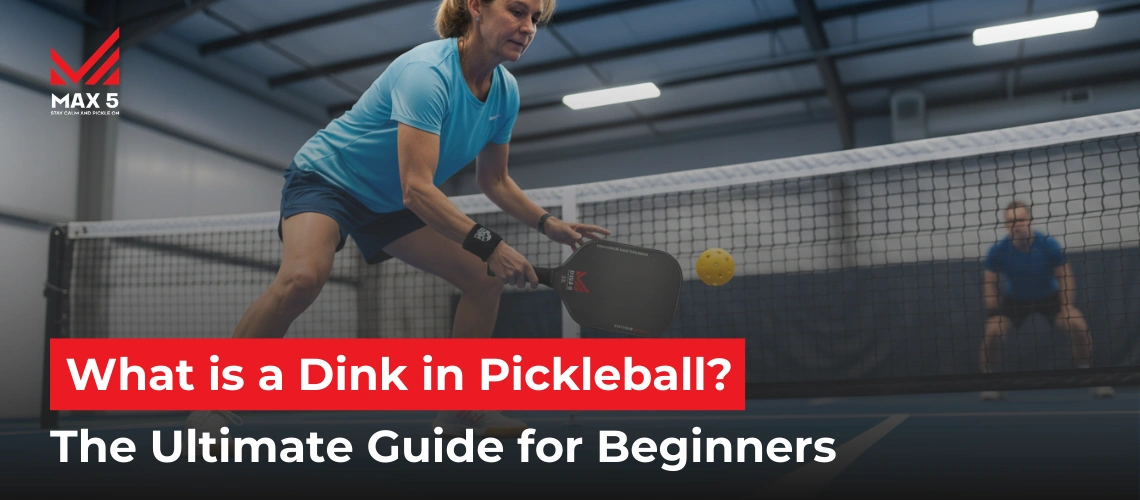
What is a Dink in Pickleball? The Ultimate Guide for Beginners
Pickleball has exploded in popularity, with participation growing over 330% from 2021 to 2024. By 2024, pickleball is projected to reach nearly 19.8 million players, fueled by its accessibility, social appeal, and expanding infrastructure, with growth expected to continue at a steadier pace. Moreover, experts predict nearly 1 in 20 Americans will be playing by 2026. If you have stepped onto a pickleball court, picked up a paddle for the first time to level up your game so it’s important to understand the dink and its principles in pickleball. Basically, dink is a soft shot that arcs over the net and lands in your opponent’s non-volley zone or kitchen. This strategic shot separates beginners from advanced players and can completely change how you control the court.
It is not about power; it’s about precision, time, and patience. But there is a thing in pickleball, it is not just trapping the ball over, it’s about controlling tempo, regarding your opponent, and owning the kitchen line. Let’s break down everything you need to know about dinking, including the latest strategies pros are using right now.
What Does “Dink” Mean in Pickleball?
It is basically your chess move in a fast-paced game. The pickleball dink meaning is simple: it’s a soft, low-speed shot hit from the kitchen zone that lands in your opponent’s kitchen. The dink meaning pickleball players understand is all about finesse over power.
Unlike aggressive drives or smashes, a dink is intentionally gentle. You’re not trying to blow past your opponent; you’re trying to draw them in, control the rally, and wait for them to make a mistake. When executed correctly, dinking means you’re playing the long game, setting traps, and dictating the pace.
A proper dink uses:
- An open paddle face
- Minimal wrist movement
- A common upward motion
- Just enough arc to clear the net safely
What Is a Dink Shot in Pickleball?
It is a shot hit after the ball bounces, typically from near the kitchen line, with the intent of landing inside the opponent’s NVZ.
According to USA Pickleball rules, pickleball dinks must be executed legally and with control. Pickleball dinks have three key characteristics:
- Trajectory: Low arc that clears the net by 1-3 inches
- Speed: Slow and controlled, giving your opponent time to react but limiting their attack options
- Placement: Must land in the kitchen zone, ideally close to the kitchen line or in awkward positions
The kitchen, or NVZ, extends seven feet from the net on both sides. This is your target zone for every dink in pickleball. When you master paddle control with equipment like the MAX 5 Vintage MX-0.1 Carbon Pickleball Paddle, which features a textured T700 carbon fiber surface designed for precision shots, you’ll notice immediate improvement in your dinking consistency.
What Is Dinking in Pickleball?
It’s more than just one shot; it’s a strategy. It is the act of engaging in repeated soft shots at the kitchen line, patiently exchanging balls until one player creates a mistake or a pop-up.
Professional players call this “dink rallies,” and they can last 10, 20, or even 30 shots. Dinking requires patience, footwork, and mental toughness. You’re essentially playing a game within the game, testing who has better touch, who stays calm under pressure, and who cracks first. According to The Dink Pickleball, advanced players improve their chances by varying their dink shot placement, spin, and pace to keep opponents off balance and avoid predictability in rallies.
The notable trend is the use of “hold dinks,” where players prepare early and delay contact slightly. This forces opponents to guess whether the next ball will be soft, sped up, or angled, often leading to positioning errors
Why Is Dinking Important in Pickleball?
Understanding why dinking in Pickleball matters is critical for long-term improvement.
- Reduces Unforced Errors: Dinks are high-percentage shots. Because the ball moves slowly, you gain more time to recover and position correctly, reducing reckless mistakes.
- Forces Opponent Mistakes: A well-placed dink demands precision from your opponent. One misjudged step or slightly high return becomes attackable.
- Controls the Pace of the Game: Dinking neutralizes power players. In doubles, especially, slowing the game removes the advantage of heavy hitters and shifts control to the more patient team.
- Creates Attack Opportunities: Most winning shots at higher levels come after several dinks, not before. Dinking builds the opening; it does not rush it.
Step-by-Step Guide on How to Dink in Pickleball
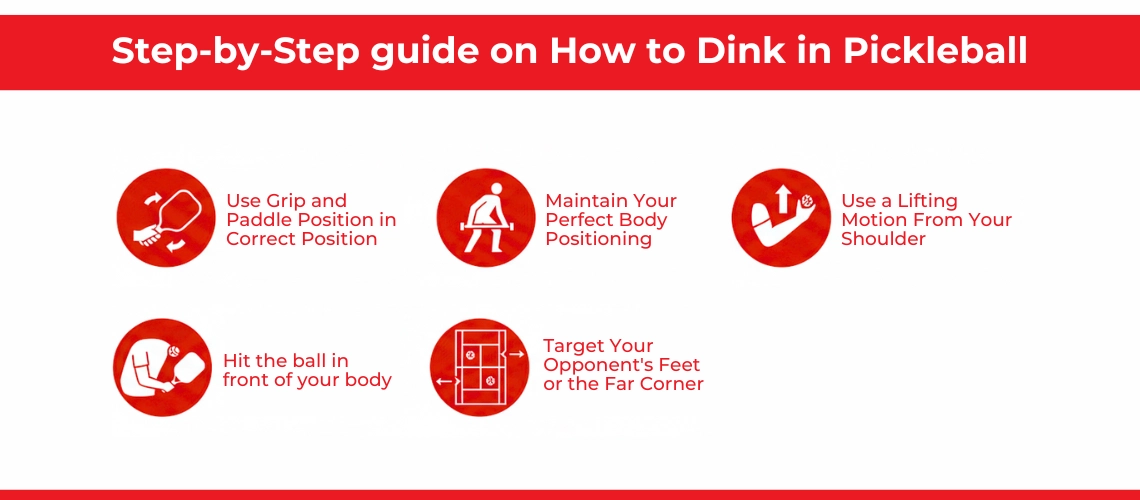
Here is a complete step-by-step guide for you to learn the dink in pickleball.
- Grip and Paddle Position: Use your standard continental grip. Keep your paddle face slightly open (angled upward). The MAX 5 Vintage MX-0.1 Carbon Pickleball Paddle, with its 16mm polypropylene honeycomb core, gives you the soft touch needed for controlled dinks.
- Body Positioning: Stand 1-2 feet behind the kitchen line, knees bent, weight on the balls of your feet. Your paddle should be up around chest height, ready to react.
- The Swing Motion: Use a lifting motion from your shoulder. There’s no backswing, which leads to overhitting. Your paddle moves from a low to a slightly higher position in a short, compact motion. Think “lift and place” rather than “swing.”
- Contact Point: Hit the ball in front of your body, ideally when it’s between knee and waist height. Contact should feel soft, almost like catching the ball on your paddle.
- Aim and Placement: Target your opponent’s feet or the far corner of their kitchen. Mix up your targets, crosscourt one shot, straight ahead the next. Keep them guessing.
Follow Through: Minimal follow-through. Your paddle shouldn’t end up above your head. Keep it controlled and compact.
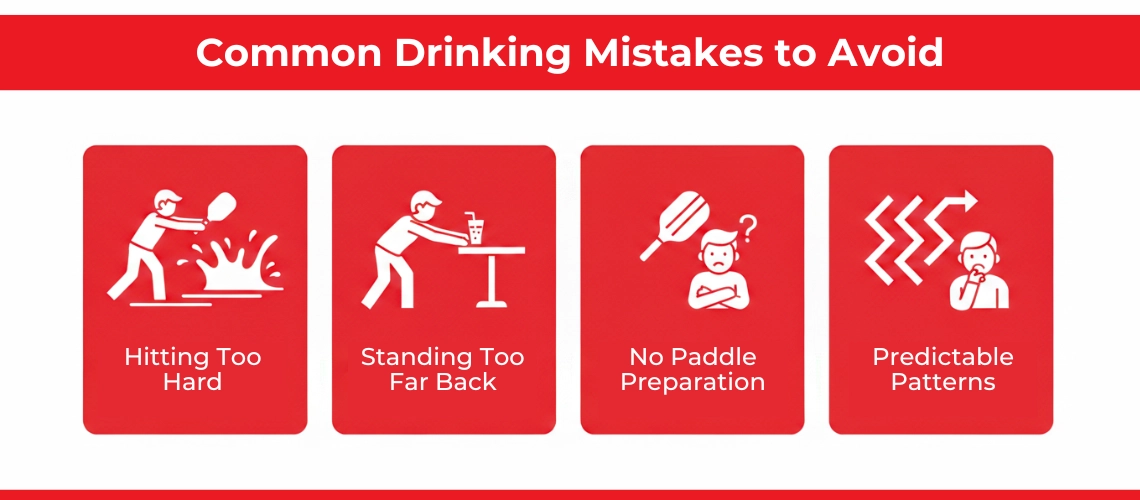
Common Drinking Mistakes to Avoid
Even experienced players struggle with these dinking errors:
- Hitting Too Hard: This is the biggest mistake. If your pickleball dinks are bouncing high or flying past the kitchen line, you’re swinging too hard. Soften your grip and use less arm motion.
- Standing Too Far Back: Playing from 5-6 feet behind the kitchen line means you can’t attack balls out of the air, and you give opponents more angles. Step up to within 1-2 feet of the line.
- No Paddle Preparation: Players who wait until the ball arrives to prepare their paddle are always late. Get your paddle up early, especially on dead balls.
- Predictable Patterns: Don’t just hit crosscourt dinks repeatedly.
Select Wrong Equipment:
Using a paddle that’s too heavy or doesn’t offer enough control makes dinking unnecessarily difficult. The MAX 5 carbon paddle at 7.8 oz provides the perfect weight for controlled dinking without arm fatigue during long rallies.
Dinking vs Other Pickleball Shots
Shot Type | Trajectory | Speed | Placement | Best Use |
Dink | Low arc | Slow | Kitchen | Control rallies |
Drive | Flat | Fast | Deep court | Aggressive offense |
Drop | High arc | Medium | Kitchen from a distance | Approach net |
Smash | Downward | High | Anywhere attackable | Finish points |
When Should You Use a Dink in Pickleball?
You should use a dink when:
- Both teams are positioned at the kitchen line
- You are facing aggressive opponents and need a reset
- You are playing doubles and want to control angles
- You are transitioning forward after a return
- You need to slow the game and regain balance
- Dinking is especially effective as a defensive reset, allowing you to neutralize pressure and regain court position.
Beginner Tips to Improve Your Dinking
Want to master what is dinking in pickleball? Try these practice methods:
- Practice Drills: Set up dink-only rallies with a partner. Go for 20 successful dinks in a row. No attacking allowed, just focus on consistency and placement.
- Focus on Consistency Over Power: Your goal isn’t tricky spin or perfect placement; it’s just keeping the ball in play. Master basic dinking before adding complexity.
- Watch Professional Exchanges: Study televised matches and YouTube tutorials to see pro dinking patterns
- Work on Your Footwork: Good dinking requires constant small adjustments. Practice shuffling side to side while maintaining balance and paddle position.
- Regularly Clean Your Paddle: Dirt and ball marks reduce your paddle’s texture and spin capability. The MX best Pickleball Eraser removes debris without chemicals, keeping your paddle tournament-ready for maximum dink control.
Conclusion
Understanding what a dink in pickleball is crucial for effective gameplay, especially at competitive levels. As we move through 2026 with new USAP rules and evolving strategies, the importance of solid dinking technique only increases. With the sport projected to exceed 20,000 courts nationwide and Gen Z and Millennials flooding into the game, competition is heating up.
Practice good technique, avoid common mistakes, and use high-quality pickleball paddles and balls to elevate your dinking game in 2026 and beyond.
Disclaimer:
Pickleball strategies and techniques discussed in this article are for general gameplay guidance only. Actual results may vary based on skill level, experience, and match conditions.