
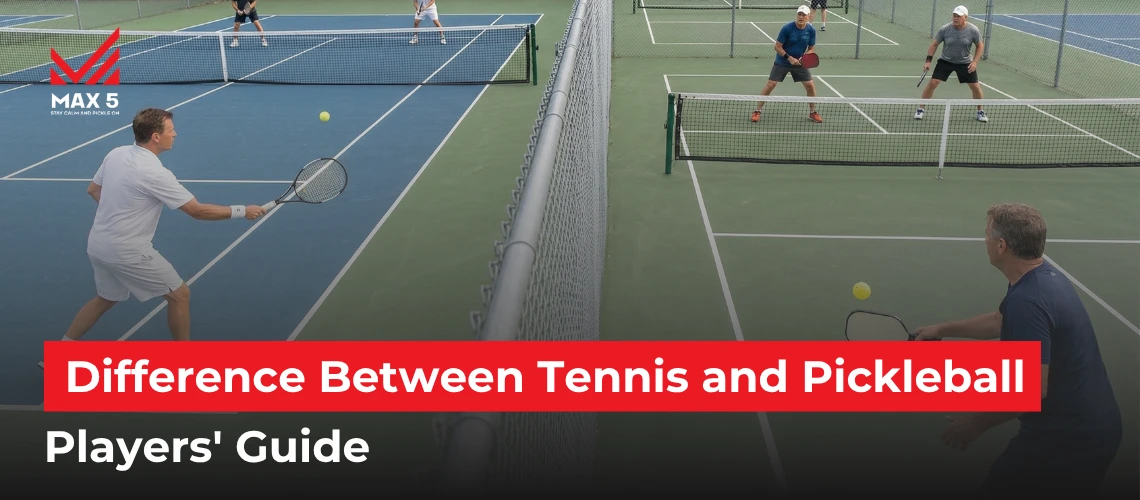
Difference Between Tennis and Pickleball: Players’ Guide
Pickleball players often hear the same question: “Isn’t pickleball just smaller tennis?” If you play pickleball, you already know the answer is no—but the differences go much deeper than court size. Understanding how tennis and pickleball differ helps pickleball players improve strategy, avoid bad habits, and confidently explain the game to others.
Interesting for you that, according to Athletech News, participation in tennis in the U.S. has surged 33% since 2020, while pickleball has increased by 59% in just three years. Pickleball has grown very popular because it is easy to access, social and a lower-impact alternative to tennis. But which sport is right for you? If you play tennis already, are just getting started, or want to understand the difference between tennis and pickleball, this guide is for you.
Overview of Tennis and Pickleball
1. Tennis
Tennis is a centuries-old racket sport played on a large court (36 ft × 78 ft for doubles). It unfolds on expansive courts where players use strung rackets to hit a felt-covered ball over a net that stands 3 ft 6 in at the posts, aiming for precision and power. Available in singles or doubles, and the scoring system (15, 30, 40, deuce) is famously intricate. Tennis demands explosive power, endurance, and swift lateral movement, making it a highly athletic sport. Professional circuits, highlighted by events from the United States Tennis Association (USTA), showcase their competitive edge.
2. Pickleball
Pickleball, a fast-emerging paddle sport invented in the 1960s, blends elements of tennis, badminton, and ping-pong. It’s played on a much smaller court (20 ft × 44 ft) with a solid paddle and a perforated plastic ball (similar to a wiffle ball). The net is slightly lower (34 inches in the centre), and the game features a unique non-volley zone (“the kitchen”) that prevents players from smashing volleys at the net. Pickleball is celebrated for its quick learning curve, social atmosphere, and lower physical impact, attracting players of all ages and skill levels. As noted by UTR Sports, its growth exploded, with communities forming rapidly due to easy entry and fun dynamics.
Court Size Comparison of Tennis and Pickleball
The court size is the first thing you will notice. Here is the quick difference between a tennis and a pickleball court in the table so you can easily differentiate them.
Dimension | Tennis Court | Pickleball Court |
Length | 78 ft (singles/doubles) | 44 ft |
Width | 27 ft (singles)/36 ft (doubles) | 20 ft |
Net height | 3 ft 6 in at posts, 3 ft in center | 3 ft at sidelines, 2 ft 10 in in center |
Total Area | 2016 for single/2808 sq ft for double | 880 sq ft |
Special zones | Tramlines for singles/doubles | 7‑ft non-volley zone (“kitchen”) on each side |
As the LTA notes, you can fit about three pickleball courts on one tennis court. This smaller size means less running and quicker exchanges, making pickleball more accessible to those with mobility limitations or who prefer a less strenuous workout.
Equipment Comparison: Rackets, Paddles, Balls & Gear
Tennis Equipment
- Racket: Strung with synthetic or natural gut, longer handle, designed for power and spin.
- Ball: Pressurized rubber with a felt cover, available in regular or high altitude versions.
- Footwear: Tennis-specific shoes with lateral support.
Pickleball Equipment
- Paddle: Solid, made of composite materials (graphite, carbon fiber) with a shorter handle.
- Ball: Plastic with 26-40 holes, lighter and slower than a tennis ball.
- Footwear: Similar to tennis shoes, but many players use court shoes with a good grip.
If you’re looking for a high-performance yet affordable paddle, the MAX5’s Carbon Pickleball Paddle offers a raw T700 carbon fiber surface for superior spin and control, with a polypropylene honeycomb core that dampens vibration. It’s USAPA-approved and ideal for beginners to intermediate players.
Serving Rules: Pickleball Favors Fair Play
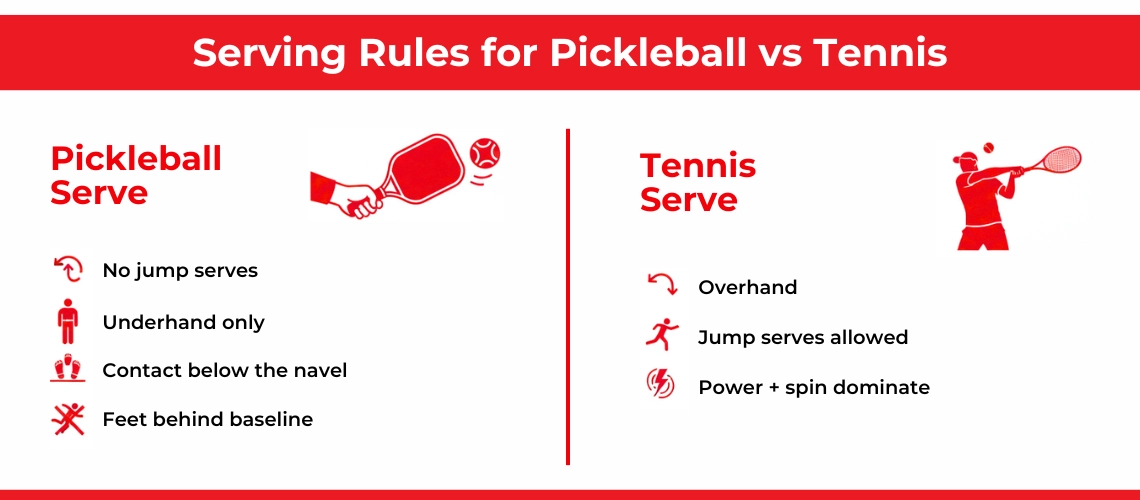
Pickleball serving rules eliminate overwhelming power.
Pickleball Serve:
- Underhand only
- Contact below the navel
- Feet behind baseline
- No jump serves
Tennis Serve:
- Overhand
- Jump serves allowed
- Power + spin dominate
2026 Pickleball Rule Updates
- Rally scoring change: Either team can score the final point, so games finish without delays.
- Stricter serves: Serves must clearly meet legal standards; questionable serves are now faults.
- Stronger conduct rules: Officials can penalize poor behavior even before play starts, with tougher rules on equipment abuse.
Scoring System: Why Pickleball Feels Mentally Tougher
Pickleball scoring demands patience.
Pickleball:
- Only the serving team scores
- Games to 11 (win by 2)
- Momentum swings quickly
Tennis:
- Points, games, sets
- Longer matches
- Less pressure per point
For pickleball players:
- Every mistake matters.
- Consistency wins more than brilliance.
Movement and Physical Demand Comparison
Pickleball is often misunderstood as “less physical,” but that’s misleading.
Pickleball Demands:
- Explosive lateral movement
- Constant ready position
- Fast reflexes at the net
- Joint-friendly movement
Tennis Demands:
- Long-distance running
- High-impact stops
- Shoulder and elbow strain
Pickleball is quick, intense, and sustainable long-term.
Which sport is best for fitness? If you want a high-intensity, full-body conditioning, tennis is the best choice for you and if you prefer a moderate-paced, social workout, which is best for joints, you can choose pickleball.
Strategy: Why Tennis Players Struggle at First
Many tennis players struggle when switching to pickleball because:
- Power shots go long
- Volleys get faulted in the kitchen
- Patience feels uncomfortable
Pickleball rewards:
- Soft dinks
- Shot placement
- Waiting for the right moment
Common Points for Tennis Players to Pickleball
- Over sized backswing: The compact pickleball court demands shorter, more controlled swings.
- Using a Western grip: Pickleball paddles lack strings, so a Continental grip is better for keeping the ball in play.
- Charging the net after serving: In pickleball, you must stay back until the third shot.
- Hitting too hard: Power often leads to out bounds errors; finesse and placement are key.
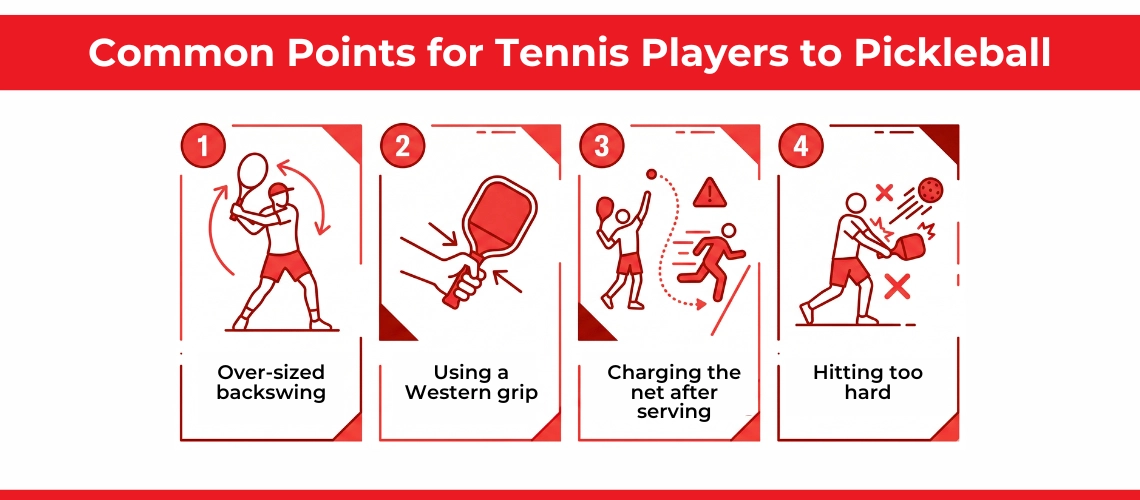
Addressing these skill transition gaps can help tennis players adapt faster and avoid frustration.
Tennis vs Pickleball for Seniors
For older adults, pickleball is often the preferred choice. The smaller court, lighter paddle, and slower ball reduce the risk of injury and strain. Studies show pickleball provides steady cardiovascular benefits without the high impact of tennis. However, tennis can be a great option for seniors who are already active and want to maintain higher-intensity fitness.
Which Is Better: Tennis or Pickleball
The answer depends on your goals, fitness level, and preferences.
Choose tennis if you:
- Want high-intensity cardiovascular training
- Enjoy individual competition and challenges
- Have time to develop complex skills
- Prefer traditional sports with professional circuits to follow
- Can handle the physical demands and court coverage
Choose pickleball if you:
- Seek a social, accessible recreation
- Need lower-impact exercise options
- Want to start playing competitively quickly
- Prefer games emphasizing strategy over power
- Have limited space or budget for equipment
Why not try both? Many players enjoy both sports, using tennis for rigorous training and pickleball for fun, social matches.
Conclusion
If you understand the difference between tennis and pickleball, it helps you to choose the sports that fit best for you. Tennis offers a powerful, competitive workout on a large court, while pickleball provides a social, strategic game that is easy to start and best or gentle on the joints. With the latest rule updates and booming participation, there’s never been a better time to pick up a paddle or racket.
Disclaimer:
This content is for general informational purposes only and does not replace professional sports, medical, or fitness advice. Participation in tennis or pickleball involves physical activity and potential risk of injury. Always consult a qualified professional before starting a new sport or exercise routine.