
How to Play Pickleball on a Tennis Court: Setup & Dimensions
If you don’t have access to a dedicated pickleball court, figuring out how to play pickleball on a tennis court can feel confusing, from court lines and net height to rules and setup. But don’t worry, the good news is that with a few simple things, you can convert a standard tennis court into a competitive pickleball court.
This guide walks you through everything you need to know, from measuring and marking the court to adjusting the net and choosing the right gear. We’ll also explore the latest 2026 trends and how to overcome common pain points so that you can enjoy pickleball right on your local tennis court.
Understanding the Key Dimension Difference
It is essential to grasp the core difference between the standard pickleball court and a tennis court. This knowledge addresses common issues, such as players struggling with mismatched dimensions that lead to erratic bounces or positioning errors.
A pickleball court measures 20 feet wide by 44 feet long for both singles and doubles, with a 3-foot non-volley zone on each side of the net. A tennis court is larger, at 36 feet wide for singles and 78 feet long for doubles, which means you will need to scale down for pickleball without altering the surface permanently.
The pickleball net stands at 36 inches high at the posts and 34 inches at the center, while on the other hand, the tennis net is taller at 42 inches at the posts and 36 inches in the middle. Without adjustments, this height difference can cause balls to sail over unexpectedly, frustrating beginners.
Max 5’s assistance: If you want to learn deeply and understand well about the court sizes and dimensions of Pickleball vs tennis . Then pick this guide for a better understanding.
Why Play Pickleball on a Tennis Court?
With an estimated 270,000 tennis courts in the United States but only about 10,000 dedicated pickleball venues, tennis courts are a vital resource for pickleball players. Tennis courts offer ideal flat surfaces, existing nets, and community access that pickleball players desperately need.
Key Benefits of Tennis Court Conversion
- Immediate access: No waiting for dedicated court construction
- Cost-effective: Uses existing public infrastructure
- Community integration: Brings pickleball to parks, schools, and clubs
- Flexible setup: Can host 1-4 pickleball courts per tennis court
Whether you’re a beginner looking for a place to learn or an experienced player seeking more court time, adapting a tennis court is a practical, cost-effective solution.
What You Need to Convert a Tennis Court for Pickleball
Preparing all necessary tools in advance helps the setup go quickly and without hassle. Here’s a checklist:
- Portable pickleball net (or a way to lower the existing tennis net)
- Measuring tape (at least 50 feet)
- Temporary court marking tape (painter’s tape, removable court tape) or chalk
- Pickleball paddles and balls choose gear designed for consistent performance, like the MAX 5 Vintage MX 0.1 Carbon Pickleball Paddle (USAPA approved for control and spin) and MX Pro Pickleballs (regulation weight and bounce for indoor/outdoor play).
- Net height adjuster (center strap or ratchet if lowering a tennis net)
- MX Clean Pickleball Eraser keeps your paddle surface free of dirt and ball marks for optimal grip.
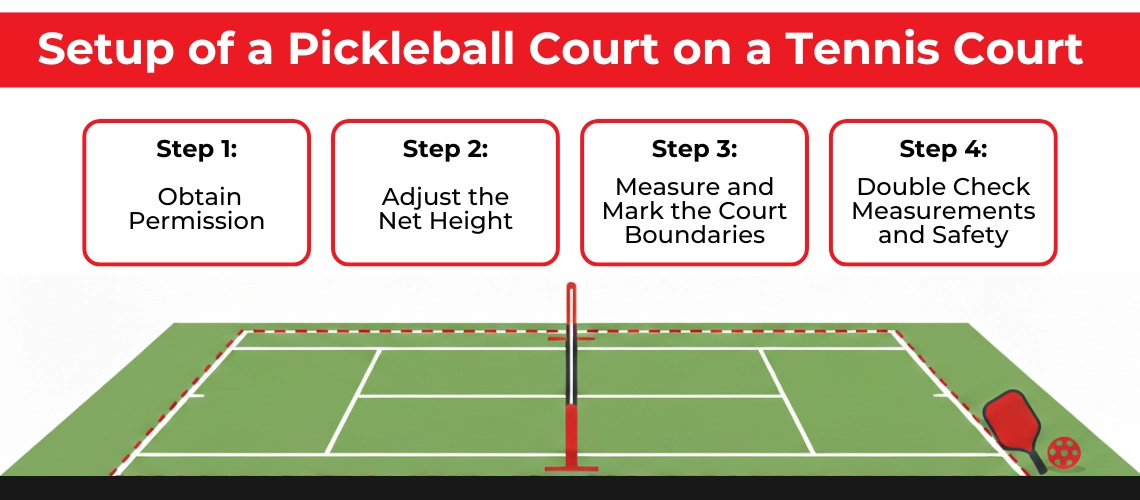
Step-by-Step Setup of a Pickleball Court on a Tennis Court
Follow these steps to convert a tennis court into a playable pickleball court.
Step 1: Obtain Permission
When you make any lines, the first thing is that you must check the owner’s court. Unauthorized making can lead to a fine or even legal trouble, so avoid any such things
Step 2: Adjust the Net Height
When you compare the nets of tennis or pickleball, the net of pickleball is shorter than the tennis net. If you are using the existing tennis net so you have two options:
- Lower the center strap to get 34 inches at the center
- Tennis net is too tall, so you will need a portable pickleball net that attaches to tennis posts and adjusts the height to 36 inches at the sidelines.
Step 3: Measure and Mark the Court Boundaries
Using your measuring tape and temporary tape, mark a rectangle 20 feet wide and 44 feet long. A common method is to:
- Start 22 feet from the net by using tape to mark the baseline
- Then measure 10 feet from each sideline inward to create the 20-foot width
- Use temporary tape and chalk to mark these boundaries clearly
The one important thing is that the non-volley zone extends 7 feet from the net on both sides. This is important for gameplay and must be clearly visible. Mark them parallel to the net and use the best color if possible
Step 5: Double Check Measurements and Safety
Walk the lines to ensure they are straight and clearly visible. Confirm the net height is correct and that all markings are secure to avoid tripping hazards.
How Many Pickleball Courts Fit on a Tennis Court?
A standard tennis court (60′ × 120′) can accommodate multiple pickleball layouts:
- One court: placed centrally for casual play.
- Two courts: side by side, ideal for small groups or coaching.
- Four courts: the maximum configuration, allowing up to 16 players to play simultaneously.
When setting up multiple courts, portable nets are essential, and using different colored tapes for each court helps avoid line confusion.
Pickleball Equipment for Tennis Court Play
Using the right gear enhances your experience on a converted court:
- Paddles: A control-oriented paddle like the MAX 5 Vintage MX 0.1 Carbon Pickleball Paddle (raw T700 carbon fiber surface, polypropylene honeycomb core) offers the spin and touch needed for fast rallies.
- Balls: MX Pro Pickleballs are USAPA-approved, with 40 precision-drilled holes for consistent flight and bounce on hard tennis court surfaces.
- Maintenance: Keep your paddle in tournament condition with the MX Clean Pickleball Eraser, which gently removes dirt and ball marks without damaging the textured surface.
Adapting Pickleball Rules for Tennis Court Play
Once the court is set, pickleball is played with standard rules, even on a tennis surface:
Key Rules
- Underhand serve diagonally across.
- Two-bounce rule: A volley is allowed only after one bounce on each side.
- Non-Volley Zone enforcement (kitchen rule).
- Games go to 11 points (win by 2).
This clears the confusion many players have about rules changing when playing on a tennis court.
Challenges and Solutions When Playing Pickleball on a Tennis Court
- Unclear Court Lines: With both tennis and pickleball lines visible, players frequently lose track of boundaries. The solution is this use a brightly colored temporary tape that contracts with existing tennis lines.
- Net Differences: The tennis net is positioned too high, altering game dynamics. The solution is to invest in a quality portable pickleball net system. These step up in under five minutes and store compactly.
- Court Sharing Protocol: Tennis players may need the court, causing scheduling conflicts. The best thing is to check with facility management about the designed pickleball and tennis court time slots
- Surface Condition Issues: Tennis courts may have cracks, debris, or weather damage affecting pickleball play, but you can sweep the court before playing, especially the marked pickleball area
Conclusion:
When you convert a tennis court into a pickleball court, it is a simple and easy way to enjoy the sport without waiting for a different court. By using the steps mentioned above, adjusting the height of the net, making a clear line for visibility, and using the right and best equipment, you can enjoy the game. By this, you can create a fun, competitive pickleball experience right on your local traditional tennis court. Pickleball is one of the fastest-growing games in the US. Adapting solutions like this will become even more valuable. So get your MAX5 pickleball paddle and balls, set up your court, and start playing
Disclaimer
This guide is for informational purposes only and may vary based on local court rules, surface conditions, and facility policies. Always follow posted regulations and obtain permission before modifying any tennis court.