
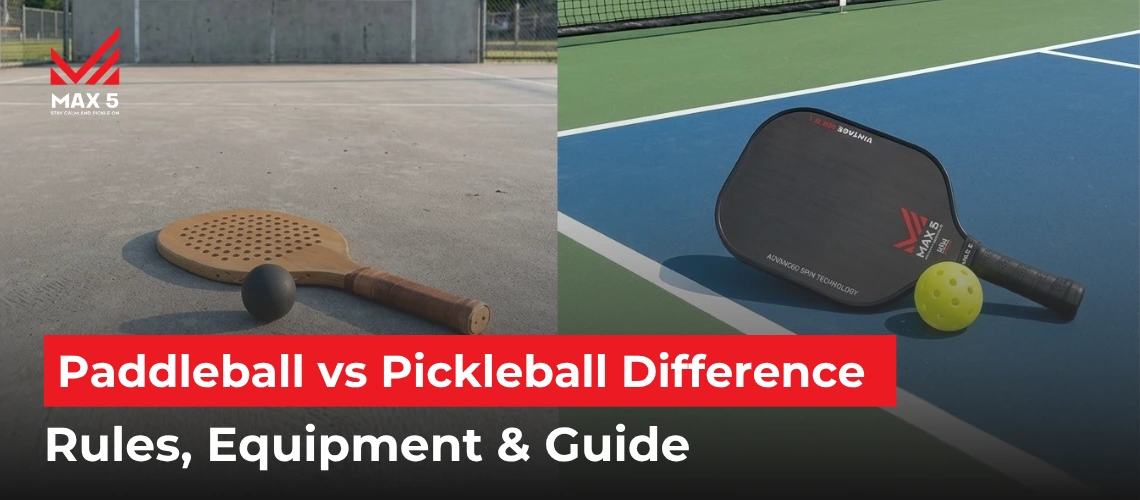
Paddleball vs Pickleball Difference, Rules, Equipment & Guide
You’ve seen both names everywhere, on gym boards, in park flyers, on social media reels. People mix them up constantly, but paddleball and pickleball aren’t the same sport. They don’t share the same court, the same rules, or even the same ball. The only thing they truly share is a paddle.
If you’ve been searching for both sports, you’re in the right place. This guide gives you everything: the real-court differences, gear details, skill demands, injury risk, and exactly which sport is worth your time in 2026.
What Is Paddleball?
Paddleball is a wall-based sport, not a net sport. Players hit a small rubber ball against a wall and try to keep their opponent from returning it.
It comes in two different formats:
- One-Wall Paddleball: Played outdoors, like in park courts or on beaches. Players face a single wall and hit the rubber ball back and forth. Popular in New York and coastal cities. Evolved from handball in the early 1900s. Governed by the USPA.
- Four-Wall Paddleball: Played in an enclosed indoor court (4 walls + ceiling). Invented by Earl Riskey at the University of Michigan in 1930. Feels closest to racquetball. Intense, fast, 360-degree court awareness required.
Paddleball is fundamentally about reaction, angles, and endurance under pressure.
What Is Pickleball?
Pickleball is an open-court, net sport invented in 1965 by three fathers on Bainbridge Island, Washington. They wanted to entertain their kids using badminton equipment and a perforated plastic ball. What started as a backyard game is now the fastest-growing sport in America, with ~24.3 million people playing in 2026, according to SFIA data.
It combines elements of tennis, badminton, and table tennis. A defining feature is the “kitchen” (non-volley zone), a 7-foot area near the net where volleys are not allowed.
The governing body is USA Pickleball (USAPA), which certifies equipment, sets official rules, and runs sanctioned tournaments through the Professional Pickleball Association (PPA Tour).
Paddleball vs Pickleball Court Difference (Wall vs Net Explained)
This is where the two sports split completely apart.
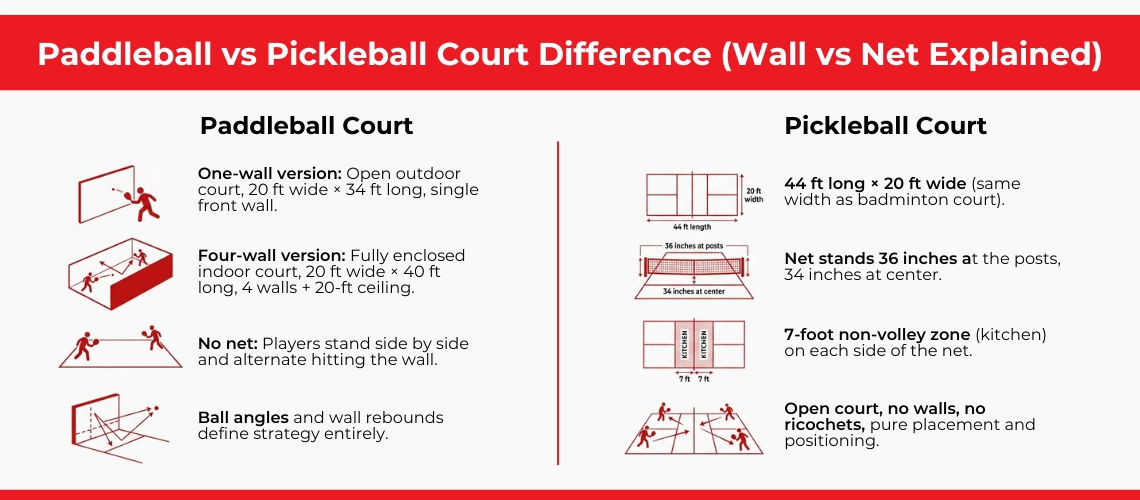
Paddleball Court
- One-wall version: Open outdoor court, 20 ft wide × 34 ft long, single front wall.
- Four-wall version: Fully enclosed indoor court, 20 ft wide × 40 ft long, 4 walls + 20-ft ceiling.
- No net: Players stand side by side and alternate hitting the wall.
- Ball angles and wall rebounds define strategy entirely.
Pickleball Court
- 44 ft long × 20 ft wide (same width as badminton court).
- Net stands 36 inches at the posts, 34 inches at center.
- 7-foot non-volley zone (kitchen) on each side of the net.
- Open court, no walls, no ricochets, pure placement and positioning.
Paddleball courts rely on walls, and finding a court is significantly harder outside of major cities. Pickleball courts are being built at record speed across the US, making it far more accessible for the average player today.
Equipment Difference (Paddles, Balls & Performance Feel)
Paddle Comparison:
Feature | Paddleball Paddle | Pickleball Paddle |
Shape | Rounder, shorter | Rectangular, flat. |
Max Length | 18 inches | 17 inches (L) per USAPA. |
Material | Wood, graphite, titanium | Carbon fiber, composite, and graphite. |
Core | Solid | Polypropylene honeycomb (most common). |
Purpose | Faster wall swings | Spin, control, soft-touch shots. |
The best pickleball paddles in 2026 use T700 raw carbon fiber faces paired with 16mm polypropylene honeycomb cores, the combination that delivers both spin and soft-touch control. The Max5 Vintage MX-0.1 Carbon Pickleball Paddle is built exactly to this spec. It’s USAPA-approved, weighs 7.8 oz (the ideal mid-weight for power and control), and is priced under $100.
Balls
Paddleball ball:
- Small, solid rubber.
- Heavier rebound, faster pace.
- Designed for wall play.
Pickleball ball:
- Hard plastic, perforated, 40 precision-drilled holes.
- Lightweight, slower through air, easier to control.
- Must meet USAPA specs: Diameter 2.874-2.972 inches, bounce 30-34 inches from 78-inch drop, hardness 40-50 Durometer D.
The balls aren’t interchangeable, a key point almost everyone searching this topic asks about on forums. Don’t try to play pickleball with a rubber paddleball. The weight, bounce, and flight characteristics are completely different.
The Max5 MX Pro Pickleballs hit every USAPA compliance mark. Seamless polymer construction, 40-hole flight pattern, calibrated 30-34 inch bounce, and come in 3-pack and 6-pack options for daily training or tournament preparation.
Rules & Scoring of Paddleball & Pickleball: Completely Different Games
Paddleball Rules:
- No net, opponents stand beside each other, both facing the wall.
- Server strikes the ball off the wall; receiver must return it off the wall.
- The ball is allowed to hit the ground only one time before being returned.
- In four-wall: the ball can hit multiple walls during a rally.
- Scoring: First to 11, 15, 21, or 25 points (win by 2). Both teams can earn points during any rally.
Pickleball Rules:
- Net divides the court; opponents face each other across it.
- Serve must be underhand, diagonal, and land past the kitchen line.
- Double-bounce rule: ball must bounce once on each side before volleys are allowed.
- Kitchen rule: no volleying while standing in the non-volley zone (ever).
- Scoring: Games to 11, win by 2. Only the serving team scores; this is called side-out scoring.
Key tactical difference:
Pickleball rewards patience, control, and structured rallies, but paddleball rewards speed, reaction, and unpredictability handling.
Which Sport Is Harder to Learn? Honest Answer for Beginners
Pickleball is easier to start, harder to master. The court is smaller, the ball is slower, and the underhand serve has a very low barrier to entry. New players can have fun within the first session. But reaching a competitive level demands deep mastery of dink strategy, third-shot drops, kitchen pressure, and reset mechanics skills that take months to build.
Paddleball has a steeper early learning curve. Wall reading is not intuitive. The ball comes back at unexpected angles, and players must develop spatial awareness for court positioning without the visual guide of a net. The four-wall version is especially demanding; it requires a fitness level comparable to squash.
Paddleball actually builds faster reflexes and better ball-tracking instincts than pickleball. Players who cross over from paddleball to pickleball often dominate at the kitchen because of superior reaction speed and hand-eye coordination developed from wall play.
Physical Demands, Fitness Benefits & Injury Risk in Each Sport
Pickleball
- Lower impact, smaller court = less explosive sprinting.
- Most common injuries: knee strain, elbow tendinitis (pickleball elbow), shoulder impingement.
- Great for players 50+ or those returning from injury.
- Competitive play significantly increases cardio demand.
Paddleball
- Four-wall version is high-intensity, comparable to squash in fitness demand.
- Constant lateral movement, 360-degree awareness, explosive direction changes.
- Harder on the joints due to rapid wall-chase sprints.
- One-wall version (beach/park play) is more recreational and lower impact.
Important Equipment Insight
A worn or dirty paddle reduces spin control and forces wrist overuse. Keeping equipment clean (e.g., carbon fiber paddle maintenance tools like MAX5 paddle care accessories) helps reduce unnecessary strain.
Which One Should You Play: Paddleball or Pickleball
Choose Pickleball if:
- Easy court access.
- Social, doubles-friendly play with a strong community.
- New to paddle sports and want a low barrier to start.
- Strategy, soft game mechanics, and patience-based rallies.
- USAPA-approved gear with clear standards and tournament matter.
Choose Paddleball if:
- Interest in wall-based sports like racquetball, squash, or handball.
- A higher-intensity, more explosive physical workout.
- Local access to paddleball courts is available (Northeast US, parks).
- Faster reflexes and unpredictable angles are appealing.
The honest reality in 2026:
Pickleball offers more courts, community, tournaments, and gear innovation than paddleball right now. If you’re starting fresh, the infrastructure and social scene alone make pickleball the smarter starting point.
Conclusion:
Paddleball and pickleball are often confusing, but they deliver completely different experiences.
- Paddleball: Wall, speed & reaction.
- Pickleball: Net, strategy & control.
If you want easy entry and social play, choose pickleball. If you want intensity and reflex training, choose paddleball. Both games are excellent; the right choice depends on your goals.
Ready to get on the court? Explore Max5’s full range of USAPA-approved carbon fiber pickleball paddles, tournament-grade balls, and paddle care accessories. Built for real players.
Follow MAX5 on Facebook and Instagram for court tips, gear drops, and pickleball community updates.
Disclaimer:
This article is for general informational purposes only and is based on commonly available rules, equipment standards, and sport descriptions as of 2026. Sport rules, equipment, and guidelines may vary by region or be updated over time. Readers should verify details with official sites such as USA Pickleball (USAPA) and the National Paddleball Association (NPA).