
How Long Do Pickleballs Last? Indoor vs Outdoor Lifespan Explained
You cracked open a new tube, played a handful of sessions, and now the ball sounds dead on contact or has split right along the seam. It happens faster than most players expect.
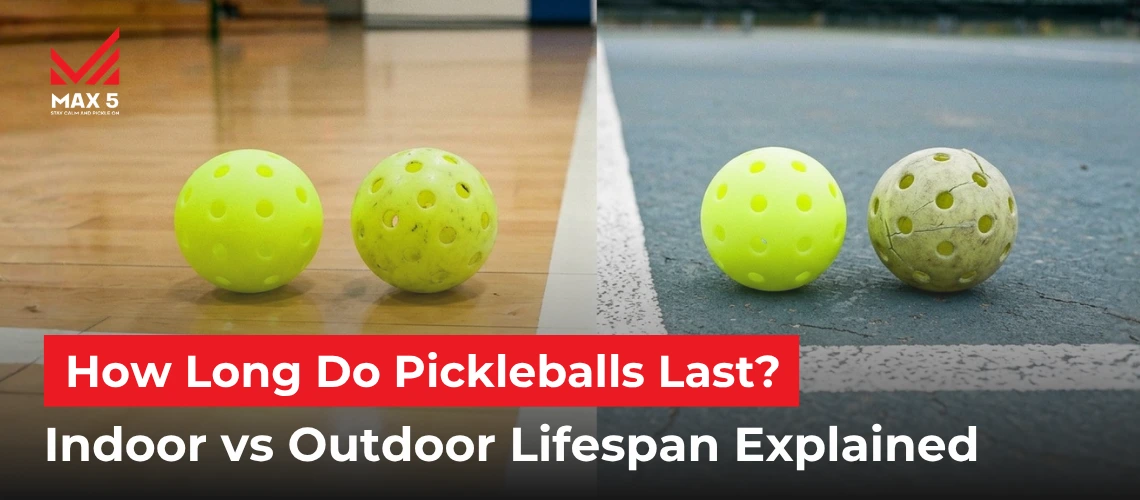
Most players asking how long do pickleballs last expect a simple number, but 3-10 games tells you almost nothing without context. The real answer depends on where you play, how you play, and what the ball is actually made of. This guide tells you exactly how long pickleballs last, why they fail, what to watch for, and how to get maximum life from every ball, whether you’re a casual weekend player or competing in league matches.
How Long Do Pickleballs Last?
Quick answer: Outdoor pickleballs last 3-10 games; indoor pickleballs last 10-15 games under normal play conditions.
Here’s what that looks like by player type:
|
Player Type |
Court |
Expected Lifespan |
|
Casual recreational |
Indoor gym floor |
10-15 games |
|
Recreational |
Outdoor asphalt |
3-7 games |
|
Competitive/league |
Outdoor hard court |
3-5 games |
|
Tournament play |
Any surface |
1-2 matches |
|
Power player (banger) |
Outdoor |
2-4 games |
|
Finesse player (dinker) |
Outdoor |
5-10 games |
A pickleball fails in performance long before it fails visually. Bounce inconsistency, a muted sound on contact, or a slight wobble mid-flight are all signs of structural degradation, even when the ball looks brand new from the outside. Players who keep using it are unknowingly training against inaccurate feedback every single rally.
Why Do Outdoor Pickleballs Die So Much Faster?
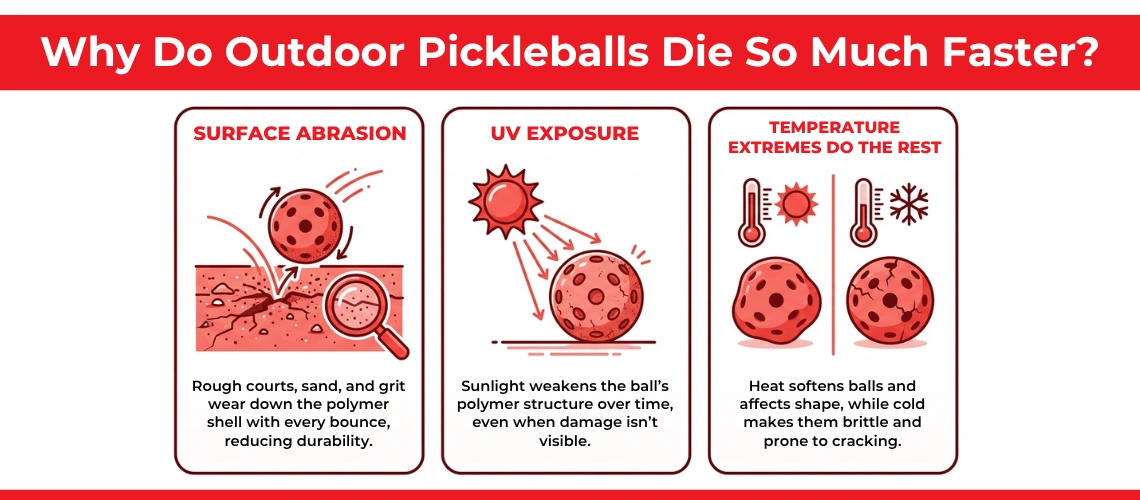
Outdoor balls face three forces that indoor balls never encounter, and these forces act simultaneously.
- Surface abrasion is the biggest factor. Every bounce on asphalt or rough concrete grinds the polymer shell at the microscopic level. Sand and grit trapped in the holes act as a miniature abrasive on every rally, thinning the shell from the inside out.
- UV exposure quietly breaks down polymer chains from the outside in. You won’t see it happening, but a ball left sitting in sunlight between sessions is structurally weaker than one stored properly, even before it’s been played.
- Temperature extremes do the rest. Above 95°F, polymer softens, and the ball loses its round shape, delivering erratic bounce. Below 50°F, it stiffens to the point where a single hard serve can split it instantly. This is why outdoor balls crack suddenly in winter it’s not bad luck; it’s cold polymer exceeding its flex tolerance.
Indoor balls on smooth gym floors face none of these. No abrasion, no UV, no temperature swings. That’s the entire explanation for why indoor balls last two to three times longer.
What Are the Signs a Pickleball Needs Replacing?
The most dangerous sign isn’t a crack; it’s the performance decline that happens weeks before one appears.
Here’s exactly what to watch for:
- Hairline crack anywhere on the shell: Retire it immediately. Even a tiny crack alters aerodynamics and bounce unpredictably, and creates a stress point that can split mid-rally.
- Soft spot: Squeeze gently. Any give means structural shell failure, not surface wear.
- Inconsistent bounce height: Drop the ball from waist height five times. Variation means the ball has lost roundness and is affecting every shot you’ve played since.
- Dull thud on contact: A healthy ball produces a bright, crisp pop. A worn ball thuds. If your warm-up sounds wrong and you can’t explain why, the ball is usually the cause.
- Flight instability: If a ball wobbles or veers off course during flight, its shape and balance may already be compromised.
- Surface pitting or color fade: Especially after UV or abrasive court exposure.
One rule that covers all of it: If you feel something is off, it probably is. Experienced players trust that instinct.
Recreational players too often keep playing and wonder why their game feels inconsistent.
What Actually Kills a Pickleball?
Understanding the real causes gives you direct control over lifespan. These are the five factors that matter most:
- Court surface: Rough asphalt and cracked concrete are the single biggest lifespan killers. Smooth sport court tiles and gym floors are dramatically gentler on polymer shells.
- Playing style: Power players who drive and smash go through balls two to three times faster than finesse players. Harder impact means faster micro-fracturing of the shell, invisible until it becomes a sudden crack mid-match.
- Temperature: Cold below 50°F makes polymer brittle. Heat above 95°F softens it. Never pull balls from a cold car and immediately serve hard; that’s how balls crack on the first rally of the session.
- Storage: Balls left in direct sunlight, a hot car trunk, or loose at the bottom of a bag degrade before they even reach the court. UV damage is silent and cumulative. A “new” ball stored carelessly for a few weeks can crack on its first session.
- Ball construction: Cheap two-piece balls crack at the welded seam within sessions. Seamless, one-piece construction eliminates that failure point.
Does Ball Quality Actually Affect How Long They Last?
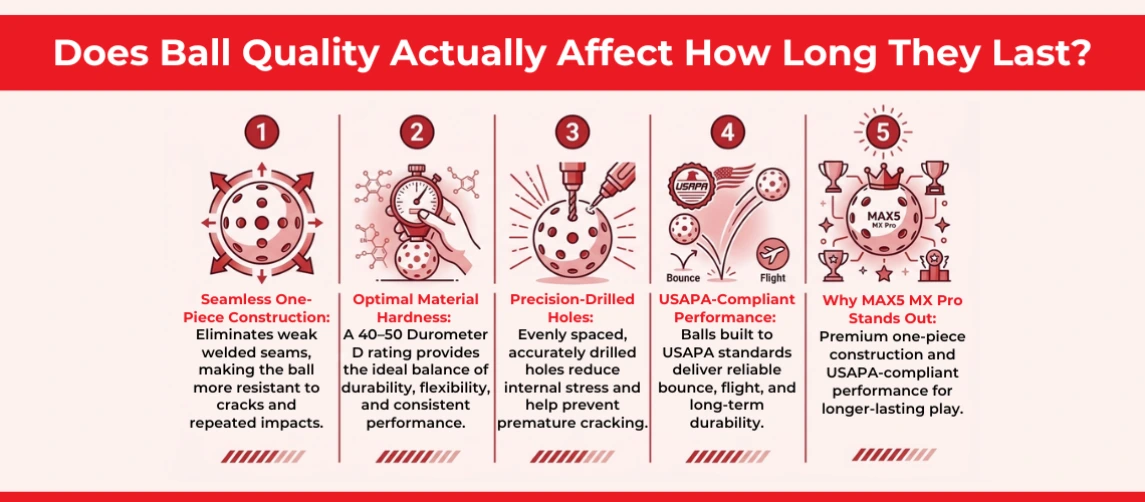
Yes, significantly, and construction matters more than price.
The most important quality factor is seamless, one-piece polymer construction. Two-piece injection-molded balls have a welded seam that becomes a structural weak point under repeated impact. That seam is almost always where the first crack appears. Seamless balls have no such point.
Material hardness is equally critical. USAPA-compliant balls sit at 40-50 Durometer D, the tested range that balances durability with real-game playability. Harder balls become dangerously brittle in cold weather. Softer balls deform too quickly under power play.
Hole precision matters too. Off-spec or unevenly drilled holes create internal pressure imbalances that become stress fractures over time. USAPA-approved balls are drilled to tight tolerances specifically to prevent this.
MAX5 MX Pro Pickleballs are built to all of these standards: seamless one-piece PE polymer construction, 44 Durometer D hardness, 40 precision-drilled holes, and a bounce calibrated at 30–34 inches from a 78-inch drop in full compliance with USAPA specifications. These are the exact construction decisions that separate balls that last five games from balls that crack after two.
- 3-Pack at $9.99.
- 6-Pack at $14.99.
How Do You Make Pickleballs Last Longer?
The single most effective habit is also the least practiced: rotate three to six balls during every session. Distributing impact across multiple balls extends each one’s useful life and keeps bounce consistent throughout practice. When you wear one ball down to nothing in a session, your training data gets worse as time goes on, and you blame your game, not the equipment.
Beyond rotation, these habits genuinely extend ball life:
- Bring balls to room temperature before cold-weather play.
- Store in the original tube, indoors, away from sunlight.
- Keep a match set and a practice set separate.
- Match the ball to the surface.
One thing that cannot extend ball life is cleaning. Unlike paddle maintenance, where the MAX5 MX Pickleball Paddle Eraser restores carbon fiber texture and spin response between sessions, ball degradation is structural and irreversible. Clean your paddle. Replace your balls on schedule.
Conclusion:
Pickleballs are consumables they always wear out. What separates smart players from frustrated ones is knowing what kills balls early, spotting the signs before performance collapses, and replacing on a schedule rather than waiting for a mid-match crack.
Court surface, temperature, storage, rotation habits, and ball construction quality are all within your control. Get those right, and every pack you buy performs better and lasts longer, start to finish.
Explore balls, paddles, and the MX Paddle Eraser at MAX5. Follow MAX5 on Facebook and Instagram for gear tips and court-tested pickleball insights.
Disclaimer:
Ball lifespan varies by court surface, climate, play style, and ball quality. Product details are accurate at the time of publication and subject to change. In this blog, the images are created by AI tools.