
How to Identify and Fix Pickleball Paddle Problems
Your paddle passed inspection in the morning and felt wrong by the third set. Your topspin shots are landing flat. That reset you’ve hit a thousand times just flew out. Something is wrong with your paddle, and it started long before you noticed.
Most paddle failures are predictable, diagnosable, and largely preventable. This guide covers every common pickleball paddle problem, what causes it, how to fix it, and most importantly, how to stop it from happening in the first place.
What Are the Most Common Pickleball Problems?
Most pickleball paddle problems fall into five categories:
- Core crush (Internal honeycomb collapse).
- Delamination (Face separation from core).
- Spin loss (Surface texture degradation).
- Grip deterioration (Loss of size, cushion, or tack).
- Edge guard damage (Structural perimeter failure).
Some issues can be fixed through maintenance. Others require immediate paddle replacement. Learning to identify early warning signs protects both your performance and your investment.
What Is Core Crush & How Do You Detect It?
Core crush is the number one paddle failure in 2026. Most players don’t catch it until performance has dropped significantly. It occurs when the polypropylene honeycomb structure collapses internally after repeated impact of stress.
Two Quick Test:
Tap test: Press your knuckle firmly across the entire paddle face in a grid pattern.
- A healthy core returns a consistent, firm, slightly resonant sound everywhere.
- A crushed zone sounds distinctly dull, flat, or hollow. That hollow zone is a collapsed cell cluster.
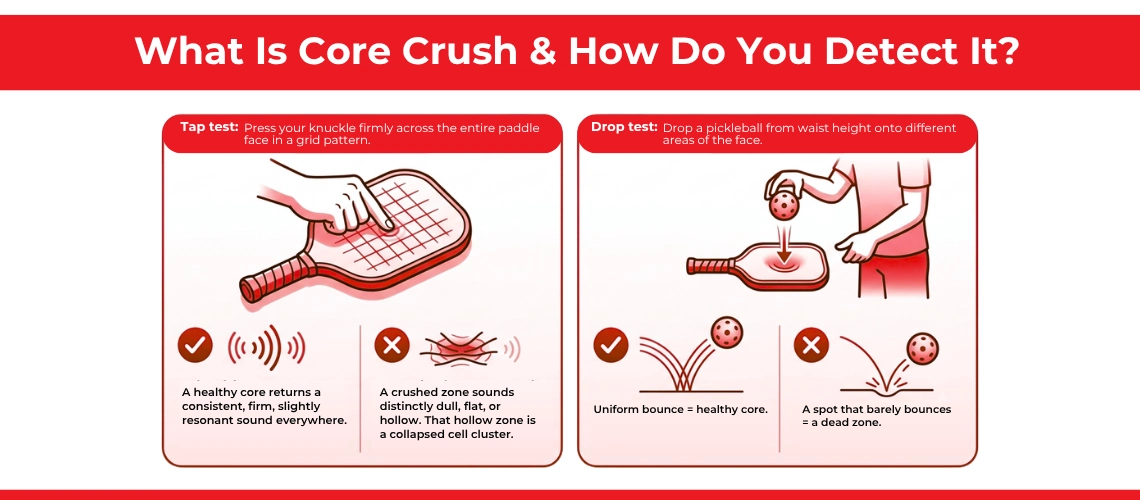
Drop test: Drop a pickleball from waist height onto different areas of the face.
- Uniform bounce = healthy core.
- A spot that barely bounces = a dead zone.
On-court Symptoms of Core Crush:
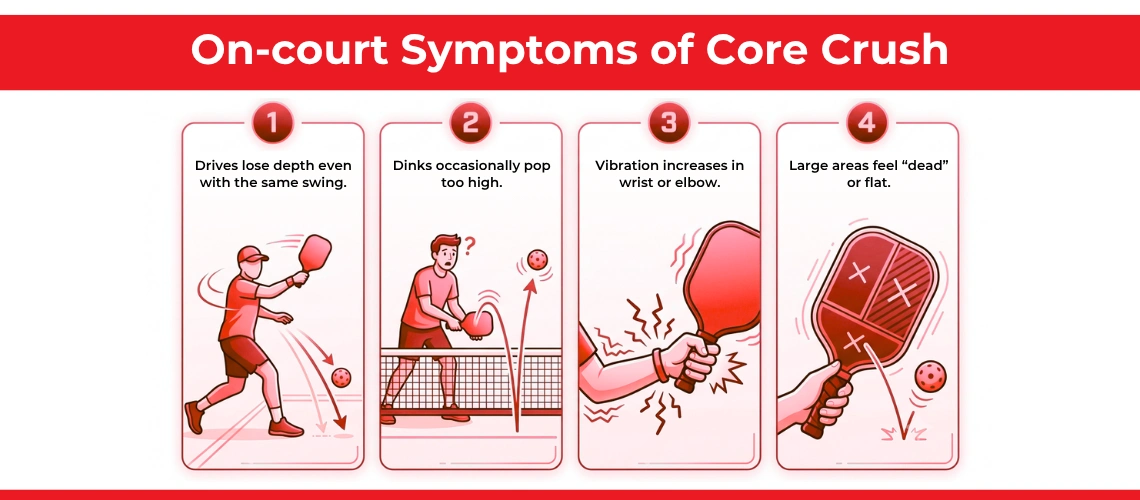
- Drives lose depth even with the same swing.
- Dinks occasionally pop too high.
- Vibration increases in wrist or elbow.
- Large areas feel “dead” or flat.
Critical 2026 update: Core crush is technically legal under USAPA rules, but it significantly disadvantages the player. Maintenance will not fix it. Once the cells collapse, the paddle must be replaced.
The Max5 Vintage MX-0.1 Carbon Paddle uses a 16mm polypropylene honeycomb core to delay compression, one of the clearest advantages over budget 13mm alternatives.
What Is Delamination and How Is It Different from Core Crush?
These two failures are constantly confused, but they behave completely differently and carry different consequences for tournament eligibility.
Feature | Core Crush | Delamination |
What happens | Internal honeycomb cells collapse inward | Adhesive bond between face and core fails |
Paddle feel | Dead, flat | Trampoline effect, uncontrollable power |
Performance | Drops significantly | Massive power but no control on dinks |
Tournament legal | Yes (but disadvantage) | No, illegal |
Fixable? | No, replace paddle | No, replace immediately |
How to tell the difference:
- Dead, flat shots with no pop = core crush.
- Shots exploding off the paddle uncontrollably, especially on resets = delamination.
- A sudden, uncontrollable spike in your paddle’s power or a hollow thud instead of a crisp pop = delamination warning sign.
Neither condition is repairable. DIY fixes, glue injection, lead tape, and surface sprays don’t restore structural integrity and can further unbalance the paddle. If you suspect delamination before a tournament, stop using the paddle immediately.
Why Are You Losing Spin? (It Is Not Your Technique)
Spin loss is the most misdiagnosed issue in pickleball. Players blame their stroke when the real problem is the paddle surface.
The T700 carbon fiber face on quality paddles is textured at a microscopic level; those micro-grooves are what grab the ball to generate topspin and slice. Over time, ball polymer residue, sweat oils, and court dust fill in those grooves and effectively smooth the surface. Once smooth, the ball slides off instead of gripping.
Symptoms:
- Topspin becomes flatter.
- Slice shots lose curves.
- Paddle surfaces appear smoother or shinier.
The fix:
Use a dry paddle eraser exclusively. The Max5 MX Paddle Eraser uses dry-rub friction to lift embedded residue from carbon fiber and composite surfaces without moisture, chemicals, or abrasion.
- Clean every 3-5 playing session.
- Use short circular motions across the hitting zone.
- Wipe residue off with a dry microfiber cloth after erasing.
- Never use wet wipes, chemical sprays, or sandpaper. These damage surface compliance or introduce moisture into the core.
Does Grip Size Cause Elbow Pain & Control Issues?
Does a grip size cause elbow pain and control issues?
Yes, grip size is one of the overlooked performance problems in pickleball and one of the most common causes of forearm pain and pickleball elbow.
- Too Small: Forces over-squeezing → Forearm fatigue and elbow strain.
- Too Large: Restricts wrist → Less spin and control on dinks.
Fix:
Replace the base grip. Overgrips and tack, but do not restore circumference.
- Daily players: Every 6-8 weeks.
- Recreational: Every 3-4 months.
Edge Guard Separation:
Run your thumbnail around the full perimeter. Any raised area or gap means separation has started. Every shot vibrates the gap wider, letting moisture into the core.
- Store in a padded bag.
- Never leave your paddle in a parked car (temperatures above 140F weaken adhesive bonds).
- Don’t rest the paddle face-down on abrasive surfaces.
How Long Do Different Paddle Materials Last?
Lifespan varies significantly by surface material, core thickness, and how often you play.
Paddle Material | Typical Lifespan | Key Weakness |
Carbon fiber (T700) | 12-24 months | Surface texture fades over time |
Fiber glass/Composite | 6-12 months | Dead spots develop faster under heavy use |
Graphite | 8-14 months | Face delaminates sooner than carbon |
Wood | 2+ years | Heavy weight, not suitable for competitive play |
What Causes Paddles to Wear Out Faster? (Avoid these Mistakes)
Most premature paddle failures are caused by the same preventable habits.
Here is what shortens paddle lifespan the fastest:
- Leaving your paddle in the car
- Playing on rough outdoor asphalt without edge protection
- Using chemical cleaners or wet wipes
- Throwing or dropping the paddle.
- Storing a wet paddle in a closed bag
- Never cleaning the surface
Prevent Rule:
- Wipe the face after every session.
- Store in a padded bag at room temperature.
- Test with the tap test monthly.
These three habits alone extend most paddle lifespans by 6-12 months.
When Should You Replace Your Pickleball Paddle?
Problem | Fix Available? | Action |
Surface spin loss | Yes | Paddle eraser, restore immediately |
Grip wear/slipping | Yes | Replace base grip |
Early edge guard lifting | Temporary only | Assess severity; stop competitive play |
Core crush (dead spots) | No | Replace paddle |
Delamination | No | Replace immediately, illegal for tournaments |
Moisture warping | No | Replace paddle |
For recreational players: 1-2 years with proper care. Most paddles begin showing wear between 6-12 months after regular use.
For tournament players: Inspect every 3-4 months using the tap and drop test. Never compete with a paddle you haven’t tested that week.
Conclusion
Paddle problems don’t happen suddenly. Core crush, delamination, spin loss, grip degradation, and edge failure are all preventable and mostly preventable.
Test monthly, clean every 3-5 sessions, store correctly, and know when to replace. Those four habits are the difference between a paddle that lasts 8 months and one that lasts 2 years.
Explore more player guides and gear care tips at Max5. Follow Max5 on Facebook and Instagram for court tips, equipment updates, and exclusive offers.
Disclaimer:
This content is for informational purposes only. Paddle performance and lifespan may vary based on usage, brand, and playing conditions. Always consult manufacturer’s guidelines before attempting any maintenance. Max5 is not responsible for any damage resulting from the advice shared in this guide.