
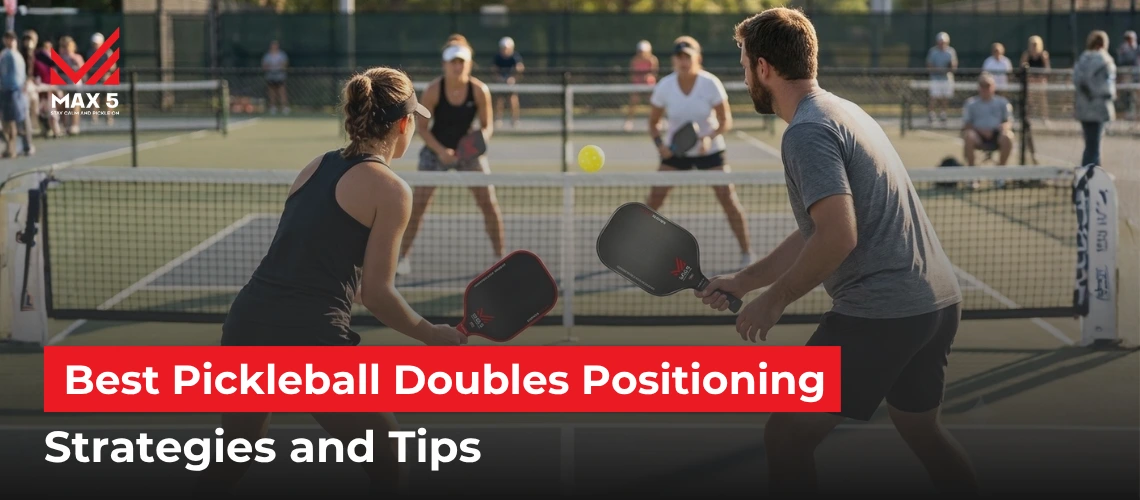
Best Pickleball Doubles Positioning Strategies and Tips
Two solid players lose points every day for one reason: They’re standing in the wrong spot, not because they hit a bad shot. Doubles pickleball runs on positioning. Where you and your partner stand before, during, and after each rally often matters more than the pace of your shots. Strong court coverage forces opponents into tougher angles, keeps the middle protected, and puts your team in control of the point.
Every rally follows the same pattern. One team serves, the other returns, both teams work toward the kitchen line, and the battle for net control begins. Understanding where to stand at each stage removes hesitation and helps both partners move as one unit instead of reacting independently.
This breakdown covers exact court spots for the serve, the return, and the transition zone. You’ll also see who takes the middle, who tracks the lob, and how to handle a banger.
Where Do You Stand at the Serve?
The server stays behind the baseline in the correct diagonal box, feet clear of the line until contact. The server’s partner stands near the baseline too, not camped at the net.
The two-bounce rule means neither of you can touch the return out of the air until it lands.
Serving Team Checklist
- Stay behind the baseline until contact.
- Keep the server’s partner near the baseline.
- Let the return bounce before hitting the third shot.
- Move toward the kitchen together after the third shot.
- Avoid rushing the net alone.
Where Does the Returning Team Set Up?
The returner stands behind the baseline in the box that mirrors the server’s position, ready to send the ball back cross-court. Their partner holds a real edge here: the two-bounce rule only applies to the serve and the return. The non-returning partner can post up right on the kitchen line before the ball even leaves the server’s hand.
That’s why returning teams often reach the net first. The returner’s job after the ball leaves their paddle is simple: follow it in. Get to the kitchen line before the third shot arrives, closing the same gap the server’s team is closing from the other side.
Here’s the full picture at a glance:
Rally Phase | Serving Team | Returning Team |
Before the serve | Server behind the baseline; partner near the baseline | Returner behind the baseline; partner already on the kitchen line |
Right after the return | Both move forward together behind the third shot | Returner follows the return toward the kitchen line |
Rally in progress | Side by side on the kitchen line, split left and right | Side by side on the kitchen line, split left and right |
A ball down the middle | Forehand-side player calls it and takes it | Forehand-side player calls it and takes it |
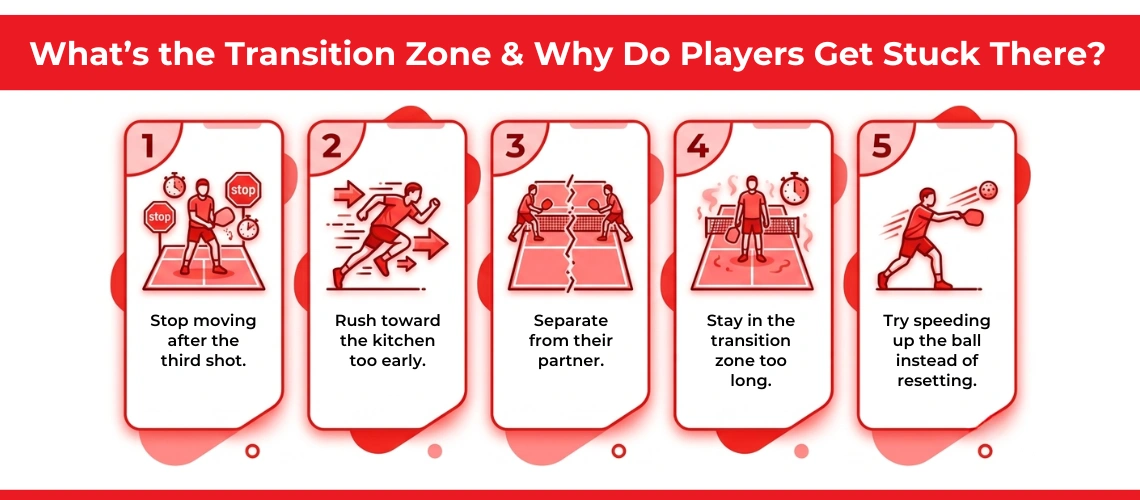
What’s the Transition Zone & Why Do Players Get Stuck There?
The transition zone, also called no-man’s-land, sits between the baseline and the non-volley zone, better known on court as “the kitchen.” Standing there mid-rally puts you too far back to put a ball away. It also leaves you too close to dig one out at your shoes.
Players get stuck here after a weak third shot or a moment of hesitation about whether to keep moving.
Players usually get stuck because they:
- Stop moving after the third shot.
- Rush toward the kitchen too early.
- Separate from their partner.
- Stay in the transition zone too long.
- Try speeding up the ball instead of resetting.
Who Covers the Middle in Doubles?
Forehand covers the middle in most cases, since a forehand reaches across the body more naturally than a backhand does. Call the ball the moment you see it coming your way, and take it. Let your partner shift over to cover the space you left open.
Middle balls cause more collisions and mix-ups than any other shot in doubles, mainly because both partners hesitate at the same time. A quick “mine” or “yours” fixes most of it. Some teams go a step further with stacking, lining up non-traditionally at the start of a point. This keeps a stronger forehand covering the middle, whichever side is serving or returning. It takes a few practice sessions to feel natural. Once it clicks, it stops a team from ever putting a weaker backhand in the middle of the court.
How Do You Defend Lobs and Hard-Hitting Bangers?
Whoever has the better angle and more time tracks the lob back. The partner shifts to guard the middle and the net instead. Never let both players chase the same ball. Call it loud and early so your partner already knows to hold the front court.
Bangers are a different problem. Against a hard-hitting opponent, drop half a step off the kitchen line instead of crowding it. That extra half-step buys reaction time on a drive at your body. This is a defensive adjustment, not a retreat. Meet the ball with a soft-handed block rather than trying to match the pace. Reset the point with a dink once you’ve got it under control, and close back into an offensive net position to keep attacking.
A mid-weight paddle matters here too. The Max 5 Vintage MX-0.1 Carbon Fiber Pickleball Paddle sits at 7.8 ounces. That’s light enough to snap up for a block, with enough carbon fiber face behind it to answer back on the next drive.
Should Both Partners Always Be at the Kitchen Line?
Side by side on the kitchen line is the position both teams want to reach. It splits the court evenly and cuts off the net. One player up and one back only happens by circumstance right after the serve, chasing a lob, or covering for an injury never by design.
The classic “up and back” formation leaves a wide gap down the middle and hands the net to the other team. Close that gap fast: Both partners should be moving toward the kitchen line together the instant the third shot leaves the paddle. Senior players and anyone who’d rather not sprint every point get the same payoff. Clean partner coverage and smart shot placement win more points than racing to the net ever will.
What Is Stacking & Should Your Team Try It?
Stacking means both partners line up on the same side of the court at the start of a point. They split apart once the ball is in play, so a preferred player ends up on their stronger side every time, whatever the score. Teams use it to keep one partner’s forehand aimed at the middle all match long, or to hide a weaker backhand from return duty.
It’s an advanced tactic, not a beginner requirement. Run it in practice with your partner a few times against a friend’s serve before trying it in a real match. That way, the footwork feels automatic once the pressure is on.
How to Keep Your Equipment Ready?
- Good positioning depends on repetition, and repetition puts wear on your equipment.
- Ball residue and court dust can build up on a carbon fiber paddle face over time, affecting feel during dinks, resets, and controlled drops.
- Cleaning your paddle regularly with the MAX5 Paddle Eraser removes surface debris without damaging the face, helping maintain consistent contact throughout practice and match play.
- Small maintenance habits won’t replace solid technique, though they help your equipment perform the same way every time you step onto the court.
Conclusion:
Court position wins more doubles points than raw power ever will. Serving from the right spot, moving with your partner, controlling the kitchen line, and communicating on every rally all help your team stay in control. Practice these movements until they become automatic, then bring them into match play.
A reliable paddle and consistent pickleballs make those practice sessions more productive, whether you’re preparing for league play or your next tournament.
Disclaimer:
This article is intended for informational and educational purposes only and should not replace official USA Pickleball rules or instruction from a qualified coach. Product recommendations are based on general gameplay considerations and individual preferences may vary.