
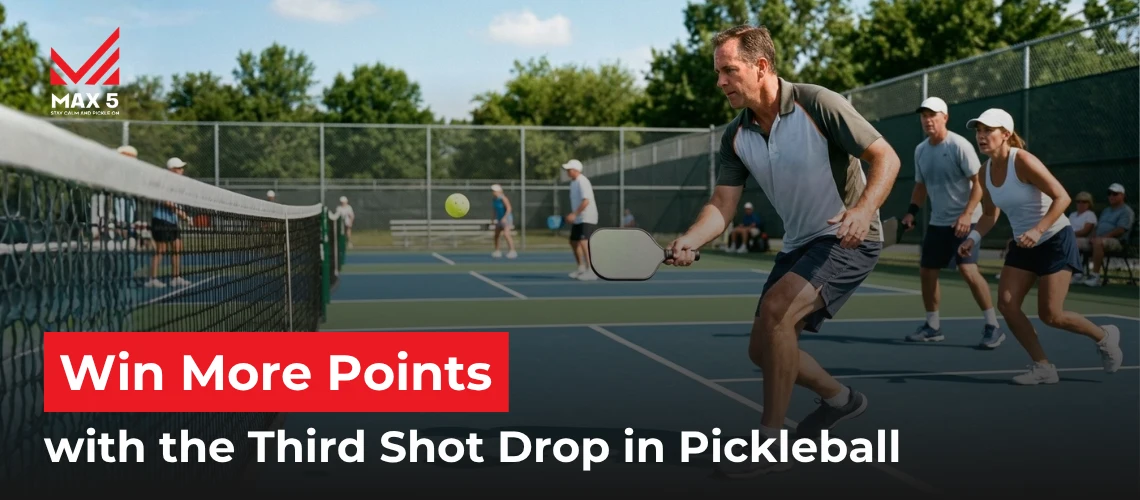
Win More Points with the Third Shot Drop in Pickleball
Your serve lands. The return comes back deep. Now you’ve got half a second to decide: float it soft, or rip it hard? That split-second call is the third shot drop in pickleball, the shot that decides whether your team walks to the net or gets stuck defending the baseline all point. What’s below covers mastering the third shot drop from the ground up: Mechanics, drills, and the exact moments to drop instead of drive.
Fast fact: 24.3 million Americans played pickleball in 2025 up 22.8% from the year before, making it the country’s fastest-growing sport for a fifth straight year, according to the Sports & Fitness Industry Association. More players fighting for the net means more pressure to own a drop you can trust.
What Is a Third Shot Drop in Pickleball?
A third shot drop is the soft, arcing shot the serving team hits on the third ball of a rally, right after the serve and the return bounce. The goal: Drop the ball into the opponent’s kitchen (the non-volley zone) so it dies low, instead of handing the returners an easy ball to attack.
Quick refresher on the sequence:
- Shot 1: The serve.
- Shot 2: The return.
- Shot 3: Your drop, low, soft, dead in the kitchen
USA Pickleball, the sport’s national governing body, teaches the drop as the bridge between the baseline and the kitchen line. Land it clean, and your team gets a free walk to the net, where most points get won.
Why Is the Third Shot Drop So Hard to Pull Off?
The drop asks you to do the opposite of every other shot in your bag: swing soft, clear a net over three feet high, and land the ball in a target the size of a welcome mat.
Most misses trace back to one of these:
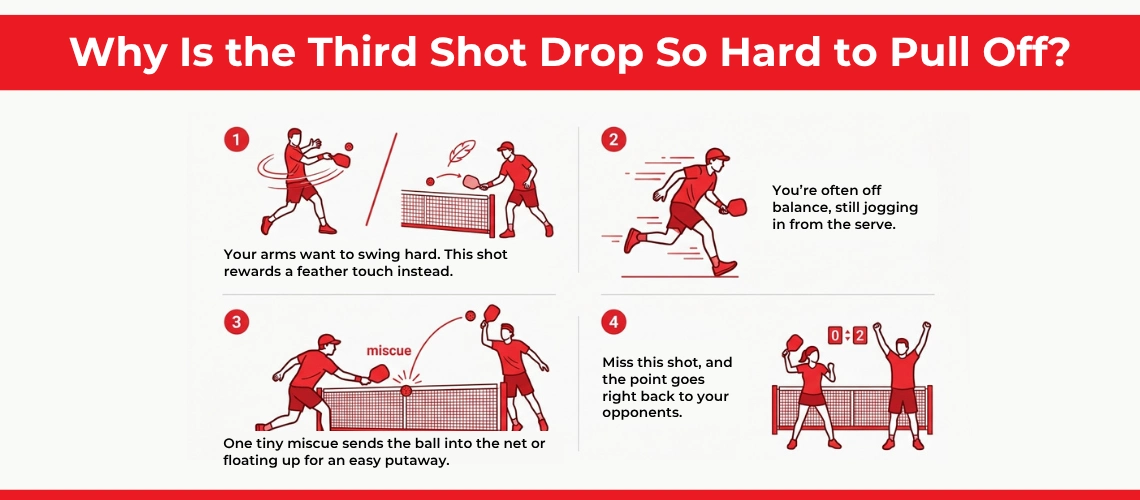
- Your arms want to swing hard. This shot rewards a feather touch instead.
- You’re often off balance, still jogging in from the serve.
- One tiny miscue sends the ball into the net or floating up for an easy putaway.
- Miss this shot, and the point goes right back to your opponents.
Even sharp players say this shot took the longest to click. That’s normal; reps fix it, not raw talent.
Third Shot Drop vs. Third Shot Drive: Which One Wins the Point?
Drop when the return is deep and low; you’re already on the back foot, so a drive just hands your opponents an easy ball to punish. Drive when the return sits up high or lands short; a low, flat drive at their feet can force a weak fourth shot before they’ve set up at the kitchen.
Aspect | Third Shot Drop | Third Shot Drive |
Best used when | Return is deep or low | The return is short or high. |
Shot speed | Soft, arcing | Hard, flat. |
Main goal | Buy time to reach the kitchen | Force a weak popup. |
Risk if missed | Low once grooved | High, power multiples errors. |
If you remember one rule for when to drive vs. when to drop in pickleball, make it this: read the return before you swing. Most missed decisions happen because a player picked their shot before the ball even bounced.
How Do You Hit a 3rd Shot Drop Every Time?
Every solid pickleball 3rd shot drop technique comes down to three moving parts: a low-to-high paddle path, a loose grip, and contact out in front of your body. Get those right, and the arc takes care of itself.
- Soft hands, not a soft arm: Keep your wrist and grip relaxed; soft hands is the exact phrase most coaches use while your legs and shoulders do the work of getting you into position.
- Aim for the middle of the kitchen, not the sidelines: A cross-court third shot drop gives you a longer runway and a lower net to clear, but consistency beats a fancy angle every time.
- Mind your third shot drop height: Most coaches put the contact point around knee height, paddle face open just enough to loft the ball over the net’s 34-36-inch midpoint.
- Follow through toward your target: Your paddle should finish pointing at the kitchen, weight already shifting forward; that’s what gets you moving to the net instead of stuck at the baseline.
- For senior players or anyone protecting their shoulder, a shorter backswing and a low-to-high wrist hinge instead of a big arm swing keeps the shot just as clean with far less strain.
What Are the Best Third Shot Drop Drills to Practice?
The fastest way to build a consistent drop is repetition, not more matches. It’s a feel skill, and feel comes from hundreds of reps.
- Solo wall drill: Stand roughly 20+ feet from a solid wall and mark a line about 34-36 inches up to represent the net. Drop-feed a ball, let it bounce, and brush it softly into your target line. This pickleball 3rd shot drop drill with a wall needs no partner and no court booking just reps.
- Partner feed drill: A partner stands at the kitchen and feeds balls from the baseline. Drop each one in, then jog forward as you would mid-rally. Fifty to a hundred reps a session builds the pattern fast.
- Drop-and-move drill: After every drop, take two steps toward the net before resetting. This builds the habit of transitioning after a third shot drop; landing the shot is only half the job.
- Count-your-makes drill: Track how many drops in a row land inside the kitchen. Chasing a personal best turns a repetitive drill into something worth showing up for.
Practicing with a paddle built for touch instead of raw power makes these reps easier to feel, the Max 5 carbon fiber paddle uses a 16mm honeycomb core specifically so soft shots don’t feel like a fight against the equipment.
What Mistakes Wreck Most Third Shot Drops?
Extra pace, standing up early, and a death grip cause almost every miss.
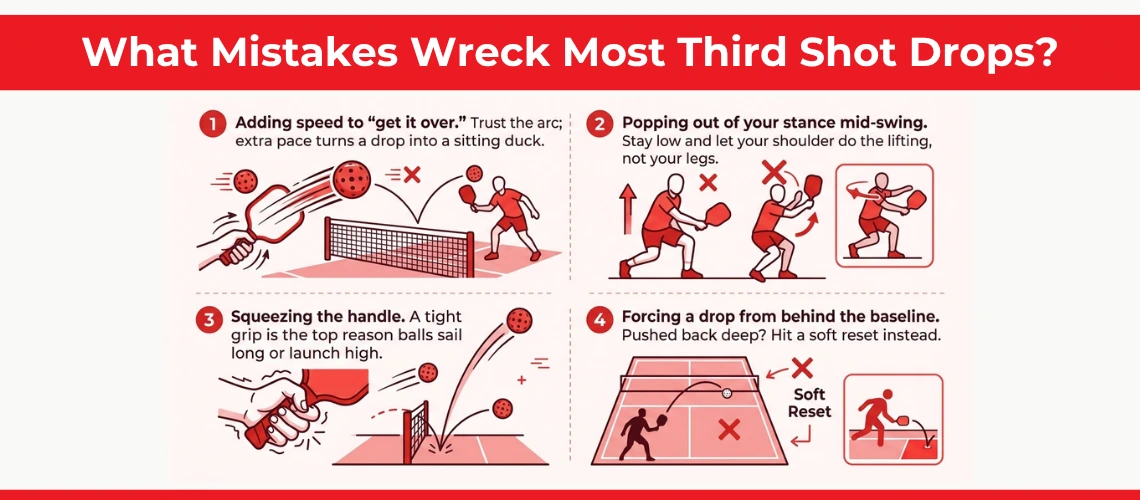
- Adding speed to “get it over.” Trust the arc; extra pace turns a drop into a sitting duck.
- Popping out of your stance mid-swing. Stay low and let your shoulder do the lifting, not your legs.
- Squeezing the handle. A tight grip is the top reason balls sail long or launch high.
- Forcing a drop from behind the baseline. Pushed back deep? Hit a soft reset instead.
Senior and social-league players with less court speed often get more value aiming a touch deeper and higher in the kitchen, trading a sliver of aggression for a wider miss margin.
A clean, grippy paddle face matters too. Residue and dead spots kill the touch this shot needs, worth a look at MAX5’s guide to cleaning a carbon fiber paddle between sessions.
Conclusion:
The third shot drop is not one shot; it’s the habit that decides whether you control the point or chase it. Groove the drop, read when to drive instead, and the kitchen line stops belonging to the other side of the net.
MAX5 was started by players chasing better gear at a fair price, and it shows in paddles built for exactly this shot: A carbon fiber face over a honeycomb core for soft, predictable touch. Grab your gear, drill the reps above, and go take the next rally.
Catch more court-side breakdowns on the MAX5 Journal, or follow MAX5 on Facebook and Instagram for weekly strategy drops.