
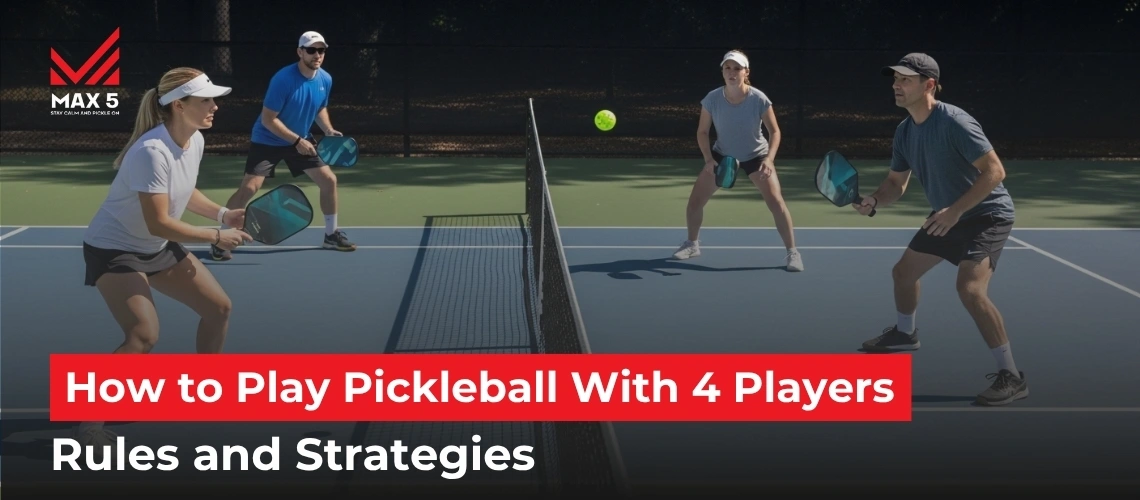
How to Play Pickleball With 4 Players: Rules and Strategies
If you’ve ever seen four people laughing, dinking, and rallying on a small court — that’s pickleball doubles in action! It’s one of the most social and exciting ways to play the game. Whether you’re new or just brushing up on the Pickleball Rules, this guide covers everything about how to play pickleball with 4 players, from scoring to positioning and serving.
Is 4-Player Pickleball a Doubles Game?
Yes. When four players are on the court (two on each side), it’s officially called pickleball doubles. This is the only format for four players as per USAPA (USA Pickleball) guidelines.
Each team has a server, a receiver, and both play an active role after the serve.
Main Difference Between Singles and Doubles
The following are some of the differences between single and double pickleball games:
Feature | Singles | Doubles |
Players | 2 (1 per side) | 4 (2 per side) |
Serving | One player per side | Both players serve before side-out |
Court | Same dimensions | Same court but more teamwork |
Strategy | Focus on endurance | Focus on coordination & communication |
Good coordination is the first Pickleball doubles strategy. Combined with quick reflexes and smarter shot placement, your strategy can let you win the match.
Pickleball Rules for Doubles (Official 2025 Version)
According to the Pickleball Rules from USAPA:
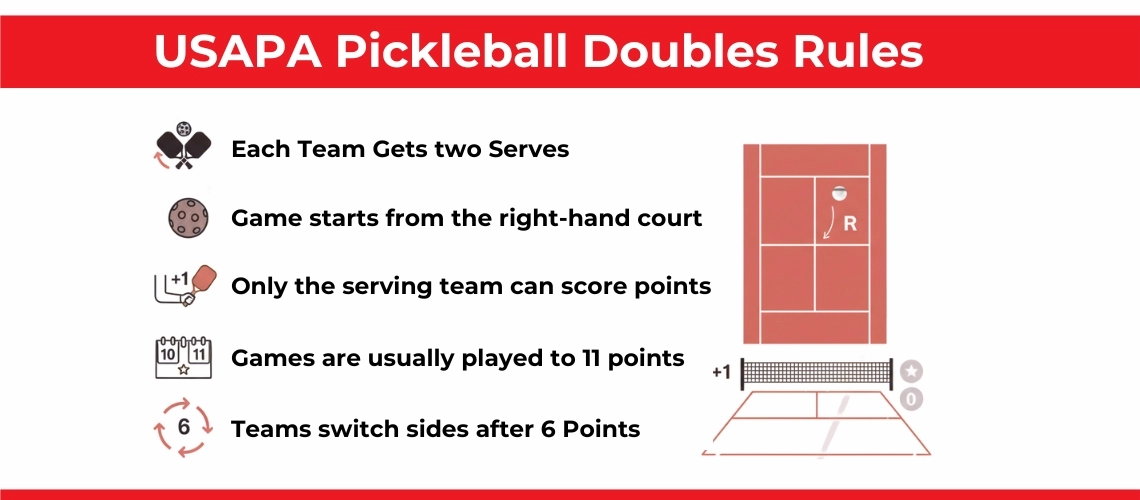
- Each team gets two serves (one per player) before the ball goes to the opponent.
- The first serve of the game starts from the right-hand court.
- Only the serving team can score points.
- Games are usually played to 11 points, but a team must win by 2.
- How to switch sides in pickleball doubles: Teams switch sides after the first team reaches 6 points (in an 11-point game) to maintain fairness under sun or wind conditions.
Pickleball Doubles Scoring
Understanding pickleball doubles scoring is crucial:
- The score has three numbers:
Server’s score – Receiver’s score – Server number (1 or 2).
Example: 5-3-2 means your team has 5, opponents have 3, and you’re the second server. - How to score pickleball: Only the serving side scores when winning a rally.
- The first server on each new side-out starts on the right.
Quick Scoring Table
This scoring table may help you understand the double.
Scenario | Server | Serving Side | Example Score |
Start of Game | One server only | Right-hand court | 0-0-2 |
After Rally Win | Same server continues | Switch sides | 1-0-2 |
Side-Out | Both lose serves | Opponent serves | 1-0-1 |
Pickleball Doubles Serving Rules
Pickleball doubles serving rules are simple but strict:
- Serve underhand below waist height.
- Paddle must contact the ball below the navel.
- The serve must land in the diagonal service court.
- No ball may land in the Non-Volley Zone (NVZ) — aka the kitchen.
Kitchen Rules Pickleball: You cannot volley (hit in the air) while standing inside or touching the kitchen line.
Pickleball Doubles Positioning & Rotation
Pickleball doubles positioning defines who serves, who receives, and where everyone stands.
- Server and partner stand on opposite sides (right & left).
- After winning a rally, the server rotates sides, but the receivers stay put.
- After both players serve and lose, it’s a side-out — the other team serves.
- Pickleball doubles rotation happens only on the serving side.
Pickleball Doubles Strategy
Try communicating before the game even starts, and keep communicating during the game too. Some more double strategies are as follows:
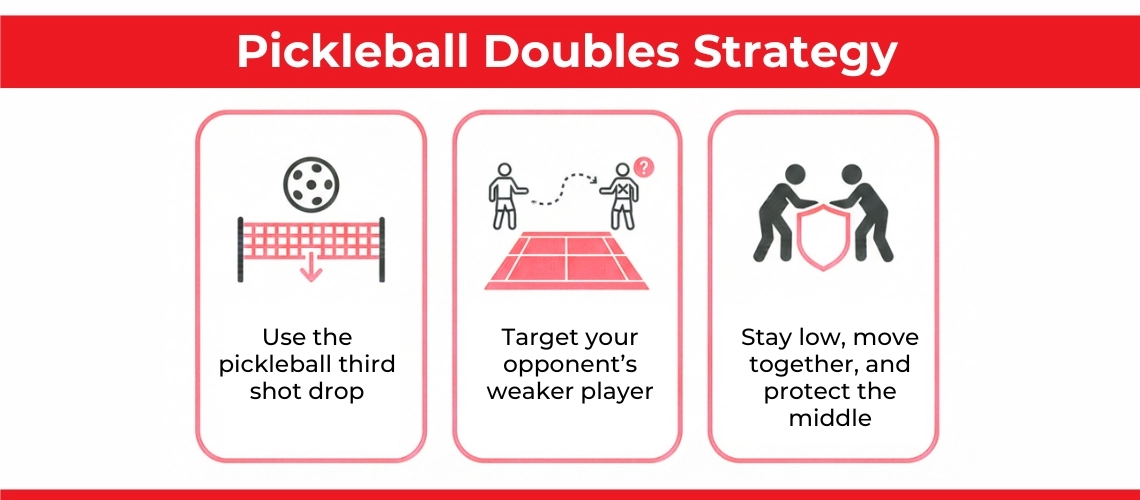
- Use the pickleball third shot drop — a soft, controlled shot that lands in the kitchen to reset the rally.
- Target your opponent’s weaker player.
- Stay low, move together, and protect the middle.
Pro tip from Max 5: Think like one — not two! Great doubles play is all about movement sync and calm control. Rest, using a paddle that gives you a perforated grip (suitable for people with sweaty hands as well), easy bounce, impressive control, and high spin, like the Max 5 Vintage MX-0.1, can definitely give you some advantage over your opponents.
Pickleball Court Layout for Doubles
Pickleball doubles court dimensions are 20 feet wide x 44 feet long.
The kitchen (non-volley zone) is 7 feet from the net on both sides.
Basic Layout
Area | Measurement |
Total Width | 20 ft |
Total Length | 44 ft |
NVZ (Kitchen) | 7 ft from net |
Service Areas | 10 ft x 15 ft each |
Winning Points in 4-Player Pickleball
The following rules can remove ambiguities in deciding the winning team, rest both teams can pre-decide if there are some changes in your game:
- Standard games go to 11 points, win by 2.
- Tournament play may go to 15 or 21 points, still win by 2.
- The least winning points possible is 11–9, since the margin must be two points.
USAPA Rules for 4 Players (2025 Update)
Per the USA Pickleball Official Rulebook 2025, Rule 4.A to 4.D specify:
- Doubles is the only 4-player format.
- Alternate serves between teammates.
- Side-out scoring applies.
- Serving faults, foot faults, and kitchen violations are enforced equally.
- New 2025 rule change: Clarified paddle contact below waistline and consistent serving motion standardization (see USAPA 2025 rule changes).
Fun Tips for 4-Player Pickleball Games
After all, it’s all about fun in the end, so never let it fade:
- Use nicknames — it lightens tension and boosts teamwork!
- Celebrate “dinks” like home runs.
- Rotate partners after every game for new chemistry.
- Keep rallies fun — not furious.
- Try the “Max 5 challenge”: play five flawless dinks in a row before attacking.
Final Word
Playing pickleball doubles (4-player format) is about rhythm, teamwork, and a dash of fun. Know your pickleball rules, master your pickleball doubles serving rules, and always play fair — that’s the spirit of this fast-growing sport.
Disclaimer: This blog is for informational purposes only and does not constitute medical, legal, or professional advice. While we strive for accuracy, errors or omissions may occur.
Some images in this blog may be AI-generated or for illustrative purposes only.