
In Pickleball What Is the Kitchen? Best Non-Volley Zone Guide
If you’re new to pickleball or even an intermediate player, one question you’ll often hear is: “In pickleball, what is the kitchen?” Understanding this critical part of the court and the rules surrounding it can dramatically improve your game and keep you out of trouble during matches.
In this guide, we’ll explain exactly what a kitchen is in pickleball (officially called the non-volley zone), the key rules, common pickleball kitchen faults, and why mastering this area is essential, all while showing how the right gear can give you a competitive edge.
What Is the “Kitchen” in Pickleball?
In pickleball, the kitchen, also called the non-volley zone (NVZ), is a critical area on both sides of the net where players are restricted from volleying (hitting the ball in the air before it bounces).
- The kitchen extends 7 feet outward from the net on each side, across the full width of the court.
- The kitchen line (also called the non-volley line) forms the boundary of the non-volley zone; that line itself is considered part of the kitchen.
- The name “kitchen” is unofficial. The formal term is non-volley zone.
In short, you cannot volley while contacting or being inside the kitchen. Everything else about entering or playing in that zone is allowed under the right conditions.
Why the Pickleball Kitchen Rules Matter
At Max5, we appreciate how the kitchen rule shapes the game:
- It prevents dominant net ramming: Without the kitchen, players could just camp at the net and smash constantly, making rallies short and unbalanced.
- It emphasizes skill over pure power: The kitchen forces players to use dinks, drops, and placement, rather than relying solely on brute force.
- It creates tactical richness: the need to move in and out of the kitchen, bait opponents, and manage momentum becomes a core part of strategy that many beginner guides skip.
- It levels the field among skill levels: since volleys must be played from farther back, beginner players have a chance to compete tactically.
With the right paddle, like the Max5 Vintage Carbon Pickleball Paddle, which offers precision control and grip stability, you can master soft shots near the kitchen line and avoid costly faults.
Official Pickleball Kitchen Rules (USAPA 2025-26 Update)
According to the USAPA rulebook (Section 9), these are the key rules:
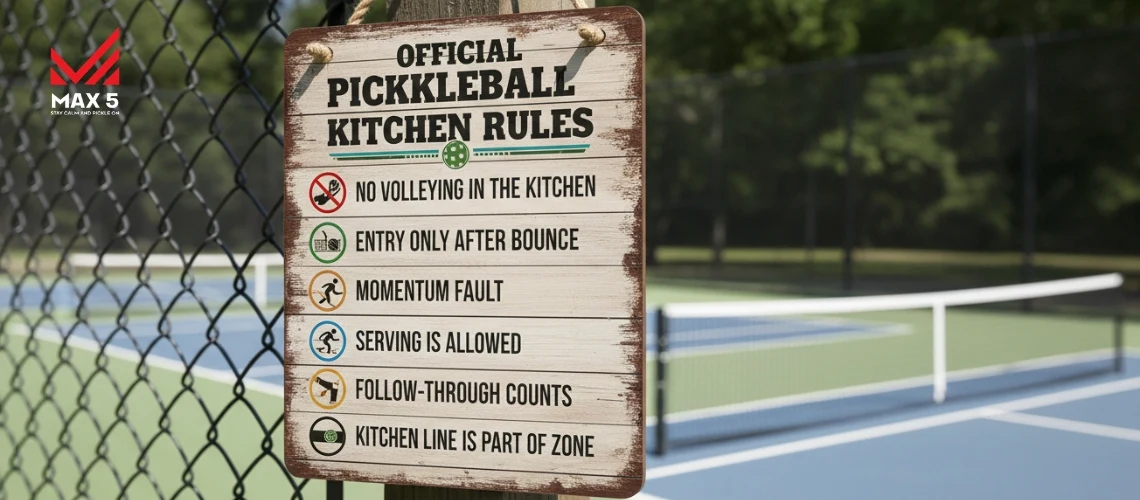
- Rule 9. A: You must start all volleys outside the kitchen. That means your feet or body can’t be inside or even touching the kitchen line when you hit a volley.
- Rule 9. B: If anything you’re wearing or holding, like your paddle, hat, or clothing, touches the kitchen during a volley, it’s a fault. This includes your follow-through and momentum after hitting the ball.
- Rule 9. C: If your momentum carries you into the kitchen after volleying, that’s a fault, even if the ball is already dead.
- Rule 9.D: Once you’ve touched the kitchen, you can’t volley again until both feet are completely outside the kitchen. For example, you can’t be in the kitchen, jump, and try to volley after landing outside; that’s a fault.
- Rule 9. E & 9. F: You’re allowed to enter the kitchen at any time except while volleying. This means you can step inside to hit a ball that’s bounced or just move around there.
- Rule 9. G: You may stay inside the non-volley zone to hit groundstrokes (i.e., shots after the ball has bounced).
- Rule 9. H: Your partner can be in the kitchen while you volley, as long as there’s no illegal contact between you during the volley.
These rules ensure that volleying remains a skilled shot, not a net-dominant brute move.
A recent 2025 rule change clarified that the act of volleying begins when the ball is struck out of the air and ends when momentum stops, which removed some ambiguity about paddle touches before or after contact.
After knowing the Kitchen rules, the next important step is to learn how to score in pickleball. This guide will make your game easy.
Common Pickleball Kitchen Mistakes
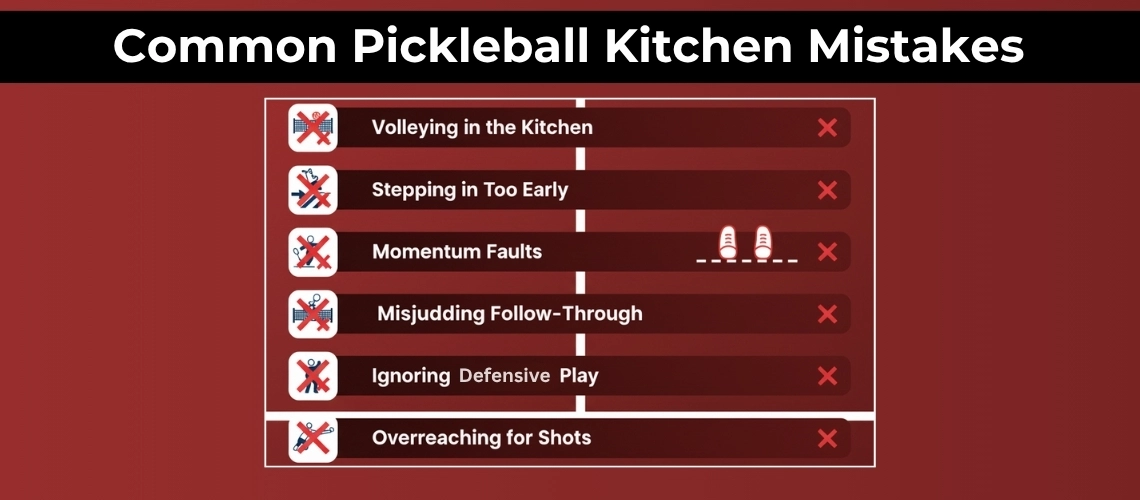
What happens if you step into the kitchen during pickleball? You commit a kitchen fault, which immediately ends the rally and awards the point to the opposing team.
To help players avoid mistakes, here are common kitchen faults:
- Volleys from inside or touching the non-volley zone
- Touching the kitchen line with any body part, paddle, or clothing when volleying
- Momentum carry-in: entering the kitchen zone because your follow-through or body moves forward
- Re volleying before re-establishing both feet outside
- Letting equipment or clothing fall into the zone during a volley (e.g., hat, paddle)
- Stepping into the kitchen during the act of volleying
Many amateurs don’t know that even a paddle tip touching the line during a volley is a fault. Faults in this zone are some of the most common in recreational and competitive play, partly because the kitchen is the hottest spot on the court. But with the right equipment, like Max 5 pickleball and practice, you can avoid these easily.
How Big Is the Kitchen in Pickleball? (Dimensions & Court Layout)
Understanding scale helps players position themselves well.
Feature | Measurement |
Kitchen length (from net) | 7 feet (each side) |
Court width | 20 feet (full width) |
Total kitchen area per side | 7 ft × 20 ft = 140 sq ft (per non‑volley zone) |
Line marking | The kitchen line is drawn parallel to the net and 7 feet out; that line counts as part of the NVZ. |
The kitchen spans 7 feet out from the net across the full width of 20 feet, totaling 140 square feet per side.
When Can You Enter the Non-Volley Zone?
Contrary to some beginner myths, you can enter the kitchen anytime, as long as you’re not volleying:
- After the ball bounces, you can step in to hit groundstrokes.
- You can stand or move inside the kitchen during rallies.
- Your paddle may swing over the kitchen line in the air during volleys, as long as no body part touches it.
Key point: Being in the kitchen is not illegal; volleying while in it or touching it is.
What Happens If You Step Into the Kitchen During a Volley?
If you step into (or touch) the kitchen during the act of volleying, it’s a fault. Consequences:
- Loss of the point or side-out.
- The fault applies even if the ball is dead.
- You must reset your feet completely outside the kitchen before volleying again.
- The ball return is invalid.
Many players fall into this mistake: volley from just outside the line, then their follow-through or momentum carries them forward into the kitchen. That’s a sure fault.
Note: If your paddle, hat, or anything you wear/carry touches the kitchen line during a volley, that also counts as a fault.
After the 2025 rule update, the rule about paddle touching before contact was removed, but if it happens during the act of volleying (after contact), it still matters.
Conclusion
Understanding the kitchen, the non-volley zone, is essential for every pickleball player aiming to improve their game and avoid common faults. The 2025 USAPA rule update clarified the boundaries and nuances of volleying near the kitchen, emphasising skill, control, and strategy over brute force. By mastering the kitchen rules, managing your momentum, and using the right equipment that is available on MAX5, you can elevate your gameplay, stay competitive, and enjoy longer rallies.
Remember, success in pickleball isn’t just about power; it’s about precision and smart positioning, especially around the kitchen. So step up your kitchen game and watch your pickleball skills soar!
Disclaimer:
This article is for informational purposes only and does not replace official USA Pickleball rules. Always refer to the latest USAPA rulebook for the most accurate and up-to-date regulations. Some images in this blog were created using AI for illustrative and educational purposes.