

Where to Put Lead Tape on a Pickleball Paddle | Max5′ Guide
If you’ve ever wondered where to put lead tape on a pickleball paddle, you’re probably looking for more power, stability, or a more personalized feel during play. Good news—customising pickleball paddle weight with lead tape is one of the easiest upgrades you can make, and when done right, it feels like unlocking a new version of your paddle.
Whether you’re playing with paddles, understanding where to put lead tape can give you that competitive edge you’ve been searching for. This guide breaks down everything you need to know about placement, weight numbers, swing weight, application, safety, legality, and more, all simply and practically.
What Is Lead Tape in Pickleball Game?
Lead tape is a thin, adhesive-backed strip used to increase a paddle’s weight or adjust its balance. In pickleball, players use lead tape for pickleball paddles to boost power, stability, sweet spot performance and overall feel.
Many brands offer ¼-inch, ½-inch, and 1-inch widths, each delivering different weight-per-inch levels, ideal for controlled customization.
Choosing the Best Lead Tape for Your Paddle
Picking the right tape sets you up for success. Go for tungsten over traditional lead. It’s denser, lead-free, and eco-friendlier. Brands like Selkirk offer tungsten strips (premium option) that are popular in 2025-26 for their precision.
Widths Matter:
- Quarter-inch (0.25-0.5g per inch) for subtle tweaks
- Half-inch (1-2g per inch) for bolder changes
- 1-inch (heavy and impactful)
Opt for heavier densities to feel the impact quicker. Pre-cut options? Super handy for a no-fuss application.
Pro tip:
In recent trends, players are using hybrid tapes with adjustable weights for even more customization. If you’re starting with the Max’5 Pickleball paddle with 7.8 oz weight, a rectangular shape, lighter tape keeps its quick-handling vibe intact.
How Much Lead Tape to Use for Pickleball Paddle:
It depends on your goal. But aim for 0.4-0.8 ounces total to avoid fatigue. It is recommended not to overdo it; start smart. A 4-inch strip of half-inch tape is about 2 grams, ideal for testing
Consider swing weight:
- Under 100 is a super headlight and fast for quick hands
- 100-110 quite headlights
- 110-119 balanced
- Over 120 head-heavy for power.
You can’t reduce swing weight by adding more. It only goes up.
Remember:
You can add swing weight. You can never decrease swing weight by adding weight anywhere. So, placement matters a lot.
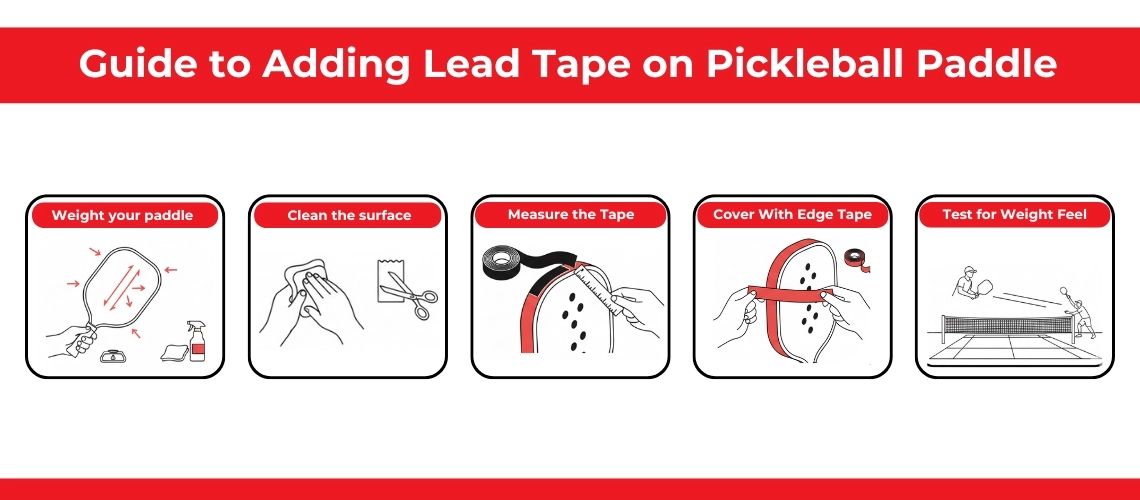
Step-by-Step Guide to Adding Lead Tape on Pickleball Paddle
Let’s get practical. First, weigh your paddle and note its balance point.
- Weight your paddle and note the balance point
- Clean the surface: Use something safe like the MX Clean Pickleball Eraser, which is available at MAX5, to wipe away dirt without damage.
- Measure the Tape: Cut the tape to size, peel, and stick firmly.
- Apply With Pressure: Smooth firmly to secure it, especially at edges.
- Cover With Edge Tape (Optional): Helps keep lead tape from peeling
- Test for Weight Feel: Try drinks, drives and resets.
Max5 players often start small and gradually increase weight to find the perfect feel. Small changes yield big results.
Did You Know?
According to The Dink Pickleball, the majority of professional players add lead tape to the top edge of their paddles because it increases head speed when swinging through the ball, adding both power and control to their games.
Benefits of Lead Tape Customization For Pickleball
The perks are real:
- Add Power: Adding mass increases force (Force = Mass × Acceleration). More mass in the paddle means more power on drives, volleys, overheads, and put-aways.
- Enhance Control and Consistency: A heavier paddle vibrates less and feels more predictable. This helps especially during quick kitchen exchanges where clean contact matters.
- Boost Stability: Off-center hits can torque the paddle. Weight added to the sides increases twist weight, reducing twisting and making the sweet spot feel larger.
- Improve Sweet Spot: Even small additions like 0.4 ounces can noticeably expand the usable sweet spot, giving player more margin for error.
Overall, it personalizes your gear, cutting errors, and building confidence. Compared to a lead tape vs a heavier paddle, tape offers targeted tweaks over a one-size-fits-all heavy model.

Common Lead Tape Mistakes to Avoid
- Adding Too Much Too Fast:Start with small amounts. Significant changes feel uncomfortable initially, even if they’ll improve performance long-term.
- Asymmetric Placement:Unless intentionally creating an imbalanced paddle, always match tape on both sides. Asymmetry causes unpredictable ball behavior.
- Not Covering Lead Tape:Lead particles can transfer to hands and face. Always cover with electrical tape for safety and longevity.
- Giving Up Too Quickly:Your muscle memory needs 3-5 games to adapt. Don’t judge immediately after the application.
- Neglecting to Document:Write down exactly what you added where. You’ll want to replicate successful configurations or adjust failed ones.
Your Path to a Customized Paddle
Lead tape empowers you to transform your paddle into a personalized performance tool. Keep these guiding principles in mind:
- Start with zone 2 (sides) for stability
- Add to zone 2 (top) weight for power
- Use zone 3 (throat) weight for control
- Make small changes and test thoroughly
- Document everything
Most players thrive in the 110-119 swing weight range, which is easily achievable with thoughtful tape placement.
Conclusion:
In summary, strategically applying lead tape to your pickleball paddle allows for tailored performance enhancements: positioning it in the head boosts power for aggressive drives, along the sides (at 3 and 9 o’clock) enhances stability and forgiveness to steady your shots, and at the throat refines control and touch without altering your swing dynamics. Ultimately, the sides remain the go-to choice for most players, striking an ideal balance of reliability and playability that elevates your game with minimal trade-offs.
With careful lead tape paddle customization, you can improve control, consistency, and confidence, making your paddle feel truly personal.
Disclaimer:
This guide is for informational purposes only. All product details and specifications are accurate; some visuals may be AI-generated or illustrative.