
How to Hold Pickleball Paddle Correctly For Power & Control
Your grip decides almost everything that happens after the ball meets your paddle. A hand placed wrong sends easy dinks into the net, turns clean volleys into shanks, and leaves your wrist sore after one long rally. Most new players pick up a pickleball paddle the way they’d pick up a tennis racket, or worse, a frying pan, and that single habit costs weeks of frustrating misses.
This guide explains the proper paddle grip, common mistakes, grip pressure, and when to make adjustments during a rally. Whether you’re picking up a paddle for the first time or refining your technique, these tips will help you play with greater confidence.
What Is the Correct Way to Hold a Pickleball Paddle?
The correct grip for most shots is the continental grip, sometimes called the neutral or “shake hands” grip. Stand your paddle on its edge, close your hand around the handle the way you’d shake hands with someone, and let your palm rest flat against one side with a slight V between your thumb and finger pointing toward your shoulder.
A proper grip should include:
- Relaxed fingers wrapped naturally around the handle.
- Your thumb resting comfortably along the handle.
- A firm but relaxed hold.
- The paddle face stays square to the ball during the ready position.
Pro move: A clenched hand between points means your grip is too tight, even if it still feels fine mid-rally.
Quick Tip: If your forearm feels tense after only a few rallies, you’re probably squeezing the handle too tightly.
What Are the Different Pickleball Paddle Grip Types?
Pickleball borrows its grip names from tennis: continental, eastern, and western. Continental works for nearly every shot in pickleball, while eastern and western rotate your hand further under the handle for extra topspin on drives.
Grip Type | Hand Position | Best For | Watch For |
Continental (Neutral) | Palm flat on top, V points to your shoulder | Dinks, volleys, resets, serves | The default for most shots, little downside |
Eastern | Hand rotated slightly under the handle | Extra pop on forehand drives | Slower to reset for a quick backhand volley |
Western | Hand rotated further under, closer to beneath the paddle | Heavy topspin off the bounce | Awkward on fast net exchanges and backhands |
Rallies at the net move fast, which is why continental stays the pick for both forehand and backhand for most coaches and Max5 players. Switching grips mid-point works in tennis, where the court gives players a beat to react. A kitchen exchange in pickleball gives you a fraction of a second, not enough time to rotate your hand between shots. For the full rulebook on paddles and courts, see the official USA Pickleball rules, the sport’s governing body.
How Tight Should You Hold a Pickleball Paddle?
Hold the paddle the way you’d hold a bird: firm enough that it won’t drop, light enough that you won’t crush it. Most players squeeze harder than they need to, and that extra squeeze causes shanks off the paddle edge and a sore forearm after a few games.
- On a 1 to 10 pressure scale, aim for a 3 or 4 on dinks and resets, easy enough that the paddle soaks up pace instead of firing it back.
- Firm up to a 6 or 7 only for drives, serves, and putaways, the shots where you’re adding your own power.
- A death grip locks your wrist, and a locked wrist sends balls long or into the net.
Pro move: Watch a high-level match between points. Loose hands reset faster than clenched ones.
How Do You Find the Right Pickleball Paddle Grip Size?
Measure from the middle crease of your palm to the tip of your ring finger with a ruler. That number in inches lands close to the grip circumference you want, and most adult players fall between 4 and 4.5 inches.
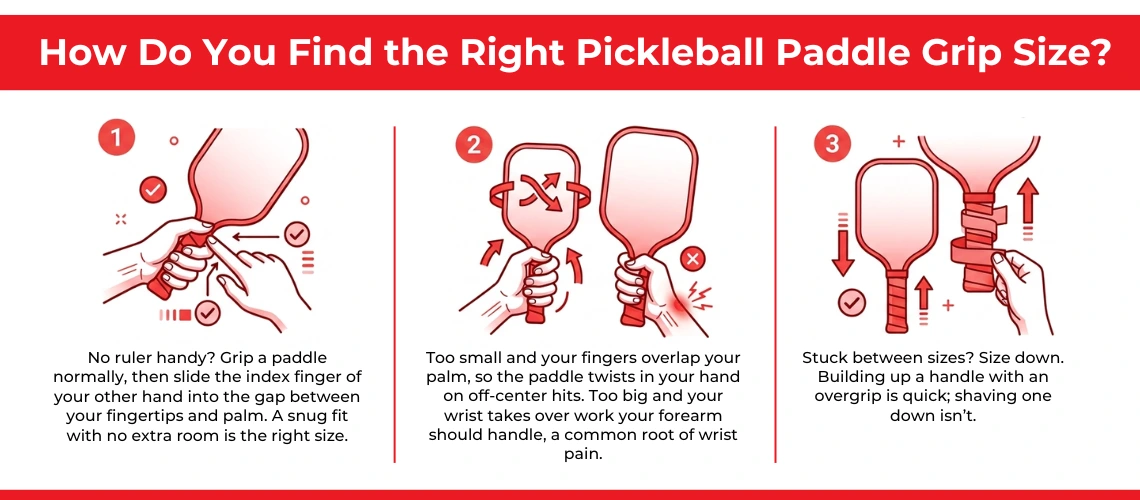
- No ruler handy? Grip a paddle normally, then slide the index finger of your other hand into the gap between your fingertips and palm. A snug fit with no extra room is the right size.
- Too small and your fingers overlap your palm, so the paddle twists in your hand on off-center hits. Too big and your wrist takes over work your forearm should handle, a common root of wrist pain.
- Stuck between sizes? Size down. Building up a handle with an overgrip is quick; shaving one down isn’t.
The Max5 Vintage MX-0.1 ships with a universal mid-size grip and a 5.3-inch handle, room enough for a second hand on backhand drives without feeling like a tennis racket in your palm.
How Should Your Grip Change for Dinks, Drives, and Serves?
Your hand position stays the same across every shot in pickleball. What changes is pressure and paddle face angle, not grip type.
- Dinks and resets: A soft hand, paddle face open slightly upward, let the ball die off the paddle instead of swinging at it.
- Drives and putaways: A firmer hand right at contact, paddle face flatter, snap through the ball instead of pushing it.
- Serves: Medium pressure with a bit of wrist snap at contact for spin, paddle face square to your target.
Load a sleeve of Max5 MX Pro pickleballs and run each shot type twenty times using the same grip. Your hand shouldn’t reset between a dink and a drive, only tighten or ease off.
How Do You Hold a Pickleball Paddle for a Two-Handed Backhand?
Add your non-dominant hand just below your primary hand on the handle, knuckles roughly lined up, keeping the same continental position underneath. A two-handed backhand trades reach for extra pop and stability on drives and high balls.
- Your top hand stays in the same neutral grip you use everywhere else. Your bottom hand adds pop, not a whole second grip to learn.
- A longer handle gives your bottom hand somewhere to sit without crowding your top hand.
- Drop the second hand for quick net volleys, there’s rarely time to bring it back mid-exchange.
What Grip Mistakes Should You Avoid?
Many players unknowingly develop habits that hold back their progress. Correcting these mistakes is often easier than changing your swing mechanics.
The most common grip mistakes include:
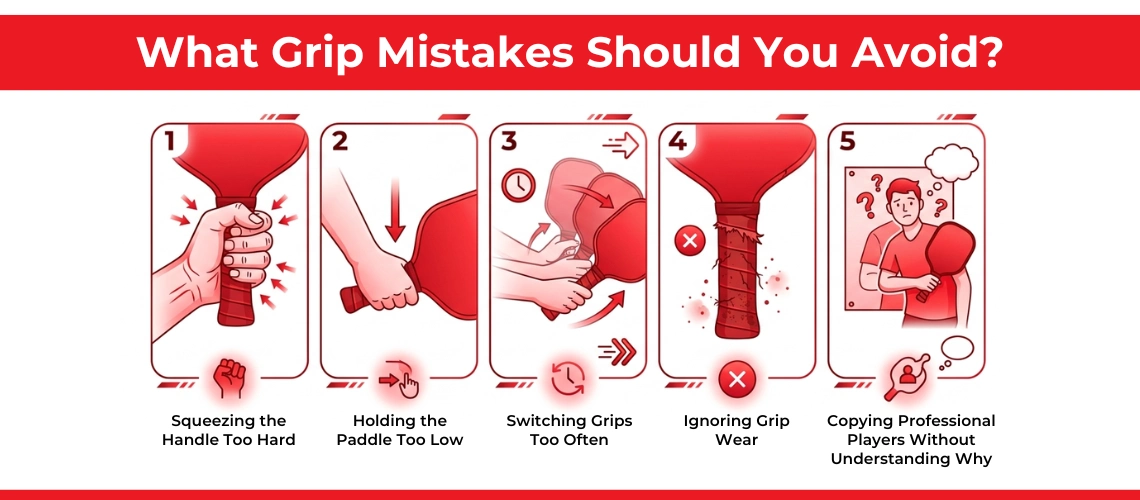
- Squeezing the Handle Too Hard: A tight grip limits paddle movement and reduces touch around the kitchen line. Relaxing your hand creates smoother resets and more accurate placement.
- Holding the Paddle Too Low: Leaving too much space above your hand reduces leverage and paddle stability. Your hand should sit comfortably near the top of the handle without covering the paddle face.
- Switching Grips Too Often: Constantly rotating your hand between forehands and backhands slows your reaction time. A continental grip lets you respond faster during rapid rallies.
- Ignoring Grip Wear: A worn grip becomes slippery as sweat builds up. Players often compensate by squeezing harder, leading to unnecessary fatigue. Replacing an old grip or adding an overgrip restores comfort and confidence.
- Copying Professional Players Without Understanding Why: Professional athletes sometimes use specialized grips for specific playing styles. Their techniques may not suit recreational or developing players. Mastering the fundamentals before experimenting usually leads to faster improvement.
Should You Change Your Grip During a Rally?
For most recreational and intermediate players, the answer is no.
Keeping one consistent grip allows you to react quickly without thinking about hand placement. Fast exchanges at the kitchen happen in fractions of a second, leaving little time to adjust your grip.
Advanced players occasionally make subtle grip changes before:
- Heavy topspin drives.
- Slice returns.
- Around-the-post shots.
- Specialty serves.
These adjustments are small rather than dramatic. Even experienced competitors return to a neutral grip immediately after the shot. If you’re still developing consistency, focus on reading the ball, moving your feet, and maintaining a balanced ready position instead of changing grips during every point. Strong fundamentals almost always outperform unnecessary complexity.
Conclusion:
Improving your grip is one of the simplest changes you can make, yet it influences every serve, dink, volley, and drive you hit. Master the fundamentals first, and your technique will become more consistent without needing complicated swing adjustments.
Grip work pays off faster than almost anything else on your practice list. Ten minutes a day, standing your paddle on its edge and finding that same neutral hand position, builds a habit your hand keeps under match pressure. Browse the full paddle and ball lineup on the Max5 shop, and catch more court breakdowns. Max5 posts quick grip fixes and court tips on Facebook and Instagram, too.
One Response