
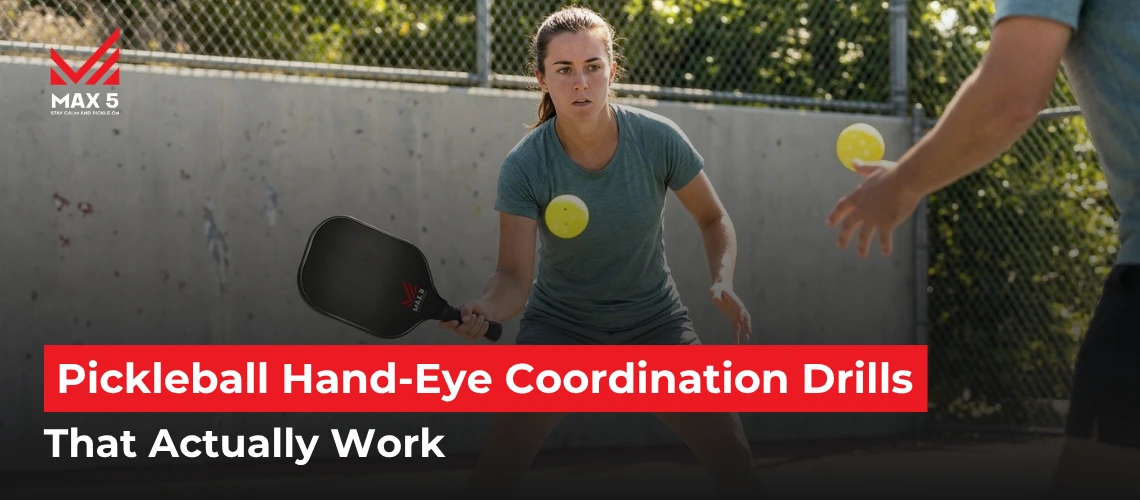
Pickleball Hand-Eye Coordination Drills That Actually Work
The ball leaves your opponent’s paddle, you watch it the whole way, and you still shank it three feet long. That gap between seeing the ball and actually controlling it is exactly what hand-eye coordination training closes.
Below are the same wall drills, reaction-ball routines, and vision exercises coaches use to improve hand-eye coordination for pickleball, sorted so a first-week beginner and a tournament regular can both start today. Grab a paddle, clear five feet of wall space, and work through them in order.
What Is Hand-Eye Coordination in Pickleball?
Hand-eye coordination in pickleball is the split-second link between spotting the ball and putting your paddle exactly where it needs to be. It blends reaction time, depth perception, and paddle control into one motion; a weak link anywhere in that chain shows up as a mishit.
A coordination problem can look like:
- Shots that clip the net tape instead of clearing it with room to spare.
- Getting stuck flat-footed on fast exchanges at the kitchen line.
- Hands feel a beat behind the ball, especially on drives.
- Clean grip and stance, but shots still land off target.
Grip plays a role here too. A loose or inconsistent grip blurs the feedback your hand gets off the paddle face, which is a big reason how you hold the paddle changes how in sync your hands feel with your eyes.
What Are the Best Wall Drills for Pickleball at Home?
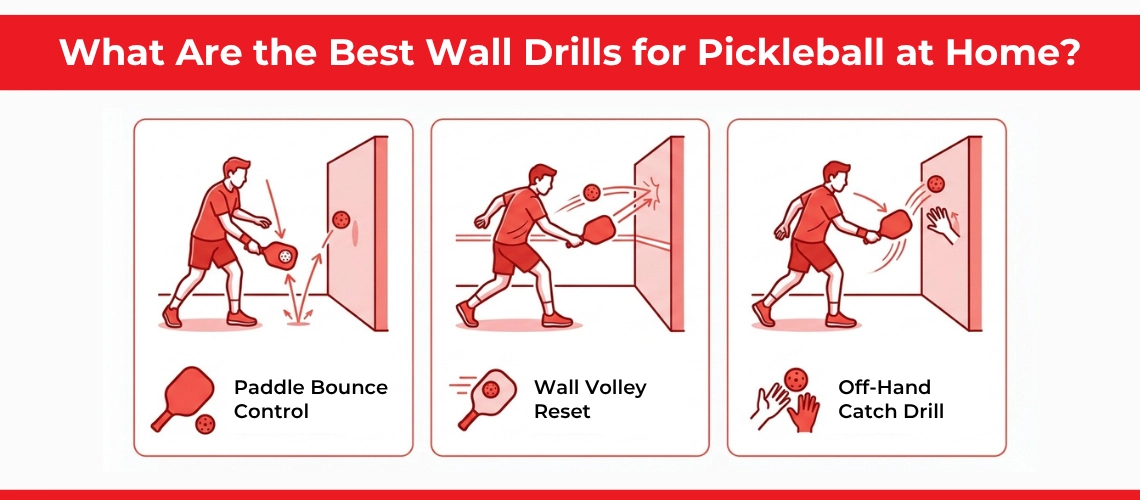
Wall drills for pickleball at home turn any flat wall into a full paddle-and-ball control drill station, no court or partner required. Three drills below need nothing but a paddle, a ball, and about five feet of clearance.
- Paddle Bounce Control: Tap the ball against the wall using only the paddle face, catching each return before it drops. Keep it inside a two-foot window and count consecutive hits. Twenty in a row is a solid beginner target; fifty-plus signals pro-level touch.
- Wall Volley Reset: From about six feet back, feed the ball to the wall and take each return as a soft volley, resetting pace like a real dink exchange. This is where soft hands absorbing pace instead of swinging at it get trained.
- Off-Hand Catch Drill: Bounce the ball off the wall with your paddle, then catch it bare-handed with your non-dominant hand before it hits the ground. Switch hands every ten reps to train both sides evenly.
Stock a couple of extra balls before you start. A stray hit off the paddle edge is common early on, and losing your only ball mid-set kills the rhythm you’re working on. A 3-pack of MX Pro Pickleballs keeps a spare within reach without the cost of a full tube.
Which Reaction Time Exercises Improve Pickleball Reflexes?
Reaction drills introduce unpredictable movement. That makes them useful for practicing responses rather than relying on a predictable rhythm.
- A reaction ball: The six-sided ball that bounces off at random angles. It is the single best training aid for this, since a wall or a partner can’t fully replicate its randomness.
- Reaction Ball Toss: Toss it against a wall or hard floor from close range and catch or paddle-block the rebound.
- Shoulder-Height Drop Catch: Have a partner drop a ball from shoulder height while you catch it before the second bounce. Ten reps per hand, both sides.
- Random-Interval Feed: A partner (or ball machine) feeds shots at irregular speeds and gaps instead of a steady rhythm, closer to what a real rally throws at you.
Getting jammed on fast drives or caught leaning the wrong way on a fake almost always traces back to reaction time, not footwork. One practical note: these drills put the ball near your face at close range, so light protective eyewear is worth having on hand.
How Can Eye-Tracking Drills Help Pickleball Players?
Your eyes need to follow the ball while your body prepares for the shot. Better visual tracking can help you read the ball’s direction and prepare the paddle earlier.
- Vision training for pickleball doesn’t need a clinic or special gear; a partner, a wall, and a couple of spare balls cover most of it.
- Near-Far Focus Shift: Improving depth perception in pickleball starts here: hold one ball close to your face and a second an arm’s length away, flicking focus between them for 20–30 seconds without moving your head.
- Head-Still Tracking: Have a partner roll or toss a ball side to side while you follow it with your eyes only, head locked forward.
- Seam-Watching: A pro-level cue is to watch the ball’s holes and seams through contact instead of its general direction. It keeps your eyes locked longer, which separates clean center-paddle contact from mishits off the edge.
- Paddle-Read Anticipation: Advanced players track the opponent’s paddle face just before contact, not just the ball once it’s already airborne. Reading the swing buys an extra fraction of a second most players never train for.
Sports-vision research backs this up. A systematic review of vision training in athletes links focused tracking and near-far drills to faster reaction time and sharper hand-eye coordination across racket sports, and a related editorial on vision’s role in sports performance points to similar gains in tracking and target acquisition after just a few weeks of targeted drills.
What Solo Drills Work Without a Partner?
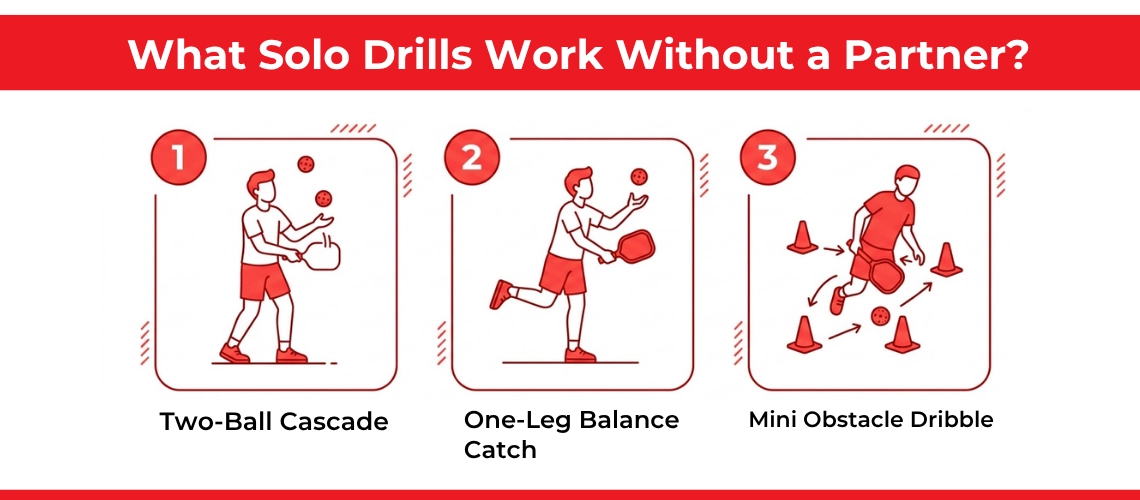
Solo pickleball drills for better reflexes rely on a wall, a mirror, or just your own hands, no court or hitting partner required. These fit into five spare minutes before or after a session.
- Two-Ball Cascade: Hold one ball in each hand and toss them in a simple pattern. Juggling for pickleball hand-eye coordination works because it forces both hands to track independent objects at once, closer to doubles play than any single-ball drill.
- One-Leg Balance Catch: Balance on one leg while tossing and catching a ball, switching legs every ten catches.
- Mini Obstacle Dribble: Set a few household objects a few feet apart and dribble the ball across the floor with your paddle, weaving through them without looking down.
Hand-eye coordination drills for seniors don’t need to change much here. Drop the balance-on-one-leg version if stability is a concern, and lean on the seated wall-tap and near-far focus drills instead. Reaction speed is trainable at any age; it just needs steadier reps, not harder ones.
Are Pickleball Training Aids Worth It for Hand-Eye Coordination?
Training aids can add variety to coordination practice, but you do not need specialized equipment to begin.
A paddle and pickleball are enough for many exercises. A reaction ball adds unpredictable rebounds, while extra pickleballs make wall practice easier.
Your paddle condition can affect consistency. A dirty or worn hitting surface may change how the ball comes off the paddle. Keeping your equipment clean helps maintain more predictable contact during practice. See our guide to common pickleball paddle problems if your paddle feels inconsistent.
Weight matters too. A paddle that’s too light skips past the ball; too heavy, and your hands lag behind it. The MX-0.1 Carbon Pickleball Paddle sits at 7.8 oz with a 16mm core specifically because that middle-ground weight lets hands reset fast at the net without giving up pop on drives a real factor in coordination drills where you’re resetting every second or two. More on dialing in paddle weight and shape in our paddle-buying breakdown.
Quick reference for your next session:
|
Drill |
Trains |
Reps/Time |
Gear Needed |
|
Paddle Bounce Control |
Touch, paddle control |
20-50 in a row |
Paddle + ball |
|
Reaction Ball Toss |
Pure reaction speed |
2-3 min sets |
Reaction ball |
|
Near-Far Focus Shift |
Depth perception |
20-30 sec, 3 sets |
2 balls |
|
Two-Ball Cascade |
Dual-hand tracking |
5 min |
2 balls |
|
Shoulder-Height Drop Catch |
Reflex speed |
10 reps/hand |
Ball + partner |
How Long Until You See Results, and What’s Next?
Most players notice cleaner contact within two to three weeks of five-minute daily reps. Real reflex gains show up faster with short, frequent sessions than one long weekly practice. Hand-eye coordination is trainable at any age and any level; it just needs consistency, not intensity.
Hand-eye coordination vs footwork is a real distinction worth knowing. Footwork gets your body to the right spot; hand-eye coordination gets the paddle to the right spot once you’re there. A player with sharp footwork and slow hands still mishits, which is why these drills stay separate from sprint or ladder work.
A simple best pickleball warmup for eye-hand coordination before you play: Two minutes of paddle bounce control, two minutes of near-far focus shifts, then straight into dinking with a partner or the wall. That short warmup wakes up the same eye-to-hand relay you’ll lean on all match.
Conclusion
Better pickleball hand-eye coordination comes from practicing how your eyes track the ball and how quickly your paddle responds. Wall volleys, paddle-control drills, reaction exercises, and simple tracking routines give you different ways to train those skills without needing a full court. Start with a few minutes several times a week and focus on clean, controlled contact before increasing speed or difficulty. As your reactions become more consistent, you can carry that control into faster volleys, drives, dinks, and kitchen-line exchanges.