
How to Choose the Best Pickleball Paddle in 2026
Most players spend more time picking a streaming service than choosing their pickleball paddle. Then they wonder why the ball keeps flying long, their arm aches after an hour, or their dinks feel impossible to control.
The paddle market in 2026 is bigger and more technically complex than ever. Carbon fiber, foam cores, thermoformed builds, Gen 3 vs Gen 4 construction it’s a lot.
But here’s the truth: You only need to understand 6 factors to make a confident, correct decision.
This guide covers all six, exposes the most common buying mistakes, and helps you choose a paddle that actually fits your game, not just your wish list.
What Level Are You Playing At & Why It Changes Everything?
Your skill level is the foundation of every paddle decision.
Buying above your level is one of the most common and expensive mistakes in pickleball.
Here’s how to place yourself honestly:
- Beginner (0-6 months): Focus on consistency, not power.
- Intermediate (6 months-2 years): Balanced control and developing power.
- Advanced/competitive (2+ years, regular tournament or league play): High spin, faster hands, and better reset feel.
Key Insight:
Most players overestimate their level when buying a paddle. If you’re unsure, go one level down. A slightly forgiving paddle accelerates skill development. An overly aggressive paddle fights you.
Should You Choose a Power Paddle or a Control Paddle?
Here is the honest answer for you if you want control, balance, and power.
Paddle Type | Best For | Trade-Off |
Control Paddle | Better touch, easier dinks, forgiveness | Less raw power |
Power Paddle | Faster balls, aggressive finishes | Less margin for error |
Simple rule:
- Beginners: Control (16mm core).
- Intermediate: Balanced (14-16mm).
- Advanced attackers: Power (13-14mm).
Key insight:
Most players don’t lose points from lack of power; they lose from poor control.
Which Pickleball Paddle Face Material for Spin & Durability?
In 2026, raw T700 carbon fiber is the performance benchmark, and it’s now accessible under $100.
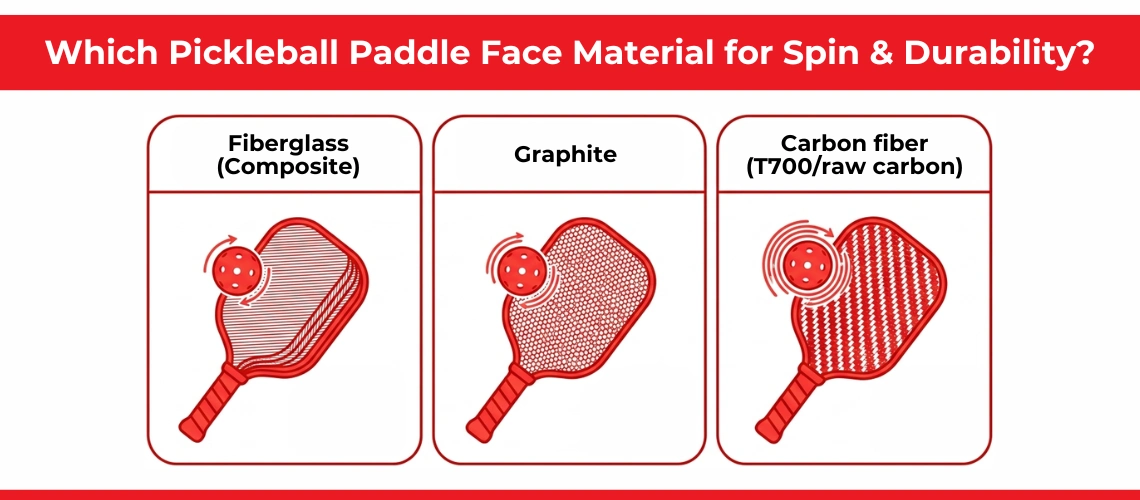
Paddle faces fall into three categories:
- Fiberglass (composite): More power, larger sweet spot, less spin. Great for absolute beginners who need forgiveness.
- Graphite: Lightweight, responsive feel, decent spin. A solid mid-range option.
- Carbon fiber (T700/raw carbon): Superior spin generation, exceptional durability, consistent touch. Preferred by intermediate to advanced players.
Important Insight:
Spin is not just grit; it’s consistency of surface contact. T700 carbon fiber delivers more predictable spin than overly gritty coatings. Because it contacts the ball more uniformly, producing controlled, repeatable RPMs rather than random bite.
The Max 5 Vintage MX-0.1 paddle uses a Max 5 paddles use T700 raw carbon fiber faces for controlled spin and long-term durability. It’s USAPA-approved, available in black ($69.99) and red ($69.99), and performs well above its price point.
Which Core Thickness Should You Choose? (13mm, 14mm, or 16mm)
Core thickness is the most underrated spec in pickleball and the one with the most direct impact on how your shots feel.
Thickness | Feel | Best For |
13-14mm | Livelier, more pop, faster response | Power players, aggressive baseliners |
16mm | Balanced control, better dwell time, softer touch | All-around players, kitchen specialists |
19mm+ | Maximum control, muted feel, ultra-soft dinks | Advanced dink-focused players |
16mm is the right choice for 90% of players.
It improves:
- Control on dinks.
- Shock absorption.
- Consistency is under pressure.
- Sweet spot forgiveness.
Max5’s MX-0.1 uses a 16mm polypropylene honeycomb core for ideal control and stability. You can get it from MAX5 with fast US shipping and satisfaction.
Are Thermoformed Paddles Worth It in 2026? (Gen 3 vs Gen 4)
Thermoforming is one of the biggest paddle innovations in 2026. It fuses the paddle into a single unibody structure using heat and pressure.
Benefits:
- More structural stability.
- Larger sweet spot.
- Increased power output.
- Better energy transfer.
Trade-offs:
- Slightly stiffer feel.
- Can favor aggressive players.
Gen evolution context:
Gen 3: Thermoformed + foam-enhanced cores.
Gen 4: Full foam-core paddles.
Verdict:
Thermoformed paddles are excellent for intermediate and advanced players, but not mandatory for beginners.
Honeycomb cores offer better long-term stability and value for recreational players.
How Do Static Weight & Swing Weight Affect Performance?
Most people only look at static weight; that is a mistake.
Static weight is the simple weight of the paddle when placed on a scale. Swing weight describes how heavy the paddle feels when you move it through the air during play.
- Low swing weight (under ~110): Fast hand.
- Mid swing weight (110-120): Balance.
- High swing weight (120+): More power.
Practical advice:
If you have elbow, wrist pain, or shoulder tightness, avoid head-heavy paddles. The Max 5 MX-0.1 is designed at 7.8 oz mid-weight balance for comfort and control.
What Paddle Shape Is Right for Your Playing Style?
Shape affects your reach, sweet spot size, and maneuverability, all at once.
- Standard/rectangular (wide body): Wider face, larger sweet spot, more forgiving on off-center hits. Ideal for beginners and doubles players who need coverage.
- Elongated: Adds 1-2 inches of reach for singles play, increases swing weight, reduces sweet spot width. Better for advanced players with consistent technique.
The honest answer: Until your shot-making is consistent, a wider rectangular shape will help you develop faster. An elongated paddle amplifies technique, good and bad.
How Do You Choose the Right Grip Size & Handle Length?
The wrong grip size causes more arm injuries than any other paddle spec.
Finding your right grip size:
Measure from the middle crease of your palm to the tip of your ring finger. That length in inches is your ideal grip circumference.
- Small: < 4.25″
- Medium: 4.25-4.5″
- Large: 4.5″+
Handle length matters too. A 5.3-inch handle accommodates two-handed backhands, a technique rapidly growing in popularity among competitive players. If you’ve come from tennis or want that two-handed stability, look specifically for this length.
Pro tip: If you fall between two grip sizes, it’s usually better to choose the smaller one. You can always add an overgrip to build up. You can’t shrink a grip that’s too large.
Does USAPA Certification Matter If You’re Not Competing?
Yes, and for a reason most buyers never consider it.
USA Pickleball certification isn’t just a competition checkbox. It means the paddle passed standardized testing for:
- Surface roughness (≤ 30µm Rz).
- Ball deflection (≤ 0.005 inches).
- Gloss level (≤ 80 GU).
- Correct dimensions and no prohibited surface textures.
Key Insight: USAPA certification prevents inconsistent ball behavior. Non-certified paddles often have uneven surface texture, meaning the ball behaves differently on different parts of the face. That inconsistency harms learning because you never develop reliable touch.
Every Max 5 paddle carries the USA Pickleball seal and meets all USAPA technical standards, making it valid for recreational play, club leagues, and sanctioned tournaments.
Paddle Maintenance (Most Players Ignore This)
One factor almost no buying guide addresses: what happens to your paddle after 20 sessions?
Ball residue, sweat, and court dust embed into the carbon fiber surface over time. This degrades spin, dulls ball response, and reduces control, slowly enough that most players don’t notice until their game feels noticeably off.
Pickleball Paddle Buying Guide 2026 (Quick Checklist)
Before you buy, verify these six things:
- Matches your skill level (beginner/intermediate/advanced).
- Core thickness: 16mm for control, 13-14mm for power.
- Face material: T700 carbon fiber for best spin and durability.
- Weight: 7.5-8.2 oz for most players.
- Shape: Standard rectangle for beginners, elongated for advanced.
- Grip fits your hand measurement.
- USAPA approved for consistent, safe performance.
Conclusion:
Choosing the best pickleball paddle in 2026 is no longer about price; it’s about fit, control, and construction quality. If you want the easiest winning formula:
- 16mmcore, T700 carbon fiber, mid-weight, correct grip size.
That combination alone fits 80% of players. It delivers forgiveness, spin, durability, and elbow protection.
Explore our full line of USAPA-approved paddles, tournament-grade balls, and paddle care accessories at MAX5 with fast US shipping and a satisfaction guarantee.
Follow Max 5 on Facebook and Instagram for court tips, gear updates, and player guides.
Disclaimer:
This blog is just here to help you easily understand pickleball paddles. Every player has a slightly different playing style, so treat this guide as a helpful reference and choose the paddle that feels most comfortable for your game.