
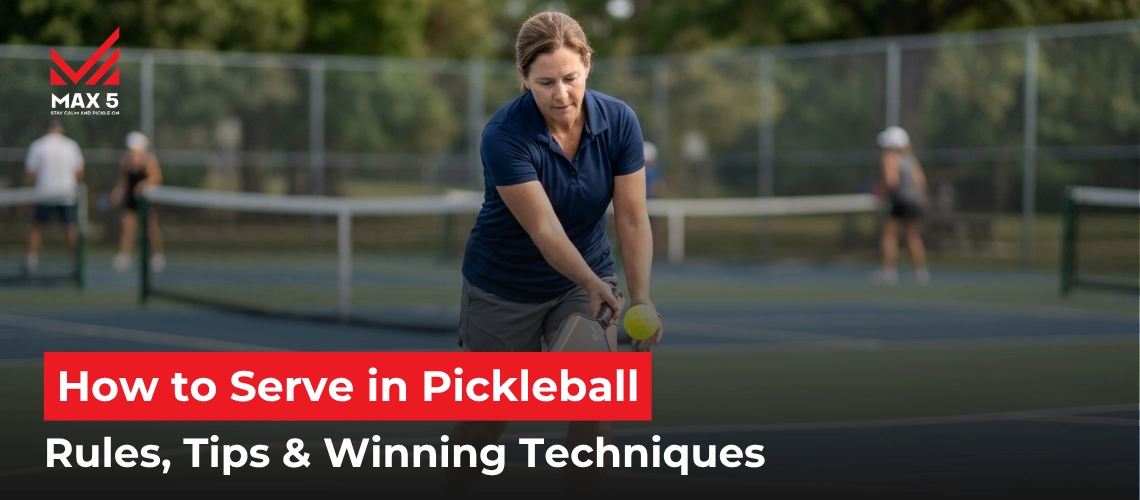
How to Serve in Pickleball: Rules, Tips & Winning Techniques
A missed serve ends the rally before your opponent even swings: no warm-up shot, no second look, just a lost point. USA Pickleball tightened the serve rules again, and plenty of players are still serving by the old version in their heads.
This guide breaks down how to serve in pickleball step by step: the stance, the swing, where the ball has to land, and which serve types actually count. You’ll get the rules that trip up new players, a legal-vs-illegal table, and real technique for placing a serve your opponent doesn’t want back. Step up to the line knowing exactly what counts.
How Do You Serve in Pickleball?
A legal serve is an underhand hit, struck below your waist, that lands diagonally into the opponent’s service box. Stand behind the baseline, release the ball, and swing low to high in one motion.
Basic form for a volley serve:
- Feet set toward your target box, one or two steps behind the baseline.
- Release the ball from one hand, roughly at waist height.
- Swing up and through, contact below your navel, paddle head below your wrist.
- Follow through toward the diagonal box, then step in behind your shot.
New to serving? The drop serve removes most of the timing pressure; more on that below.
What Are the Official Serving Rules in Pickleball?
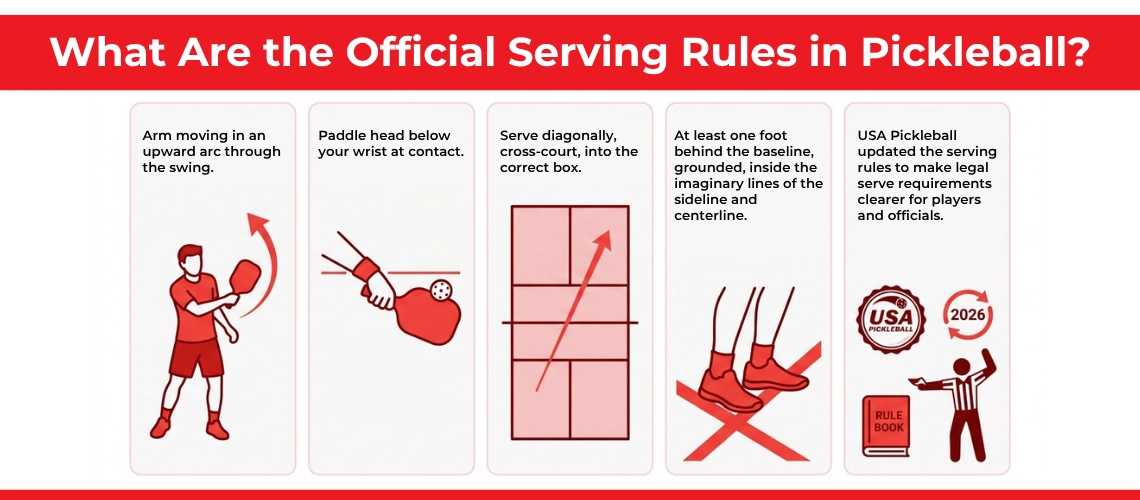
USA Pickleball’s rulebook sets five core rules for a volley serve, and the 2026 update made them stricter to call.
Break anyone, and it’s a fault:
Contact the ball below your waist (the rulebook marks this at your navel)
- Arm moving in an upward arc through the swing.
- Paddle head below your wrist at contact.
- Serve diagonally, cross-court, into the correct box.
- At least one foot behind the baseline, grounded, inside the imaginary lines of the sideline and centerline.
New for 2026:
USA Pickleball updated the serving rules to make legal serve requirements clearer for players and officials.
Who Serves First, and How Many Serves Do You Get?
A coin toss decides who serves first, and that side gets only one server before the first side-out. After that opening turn, the rules split by format.
- Doubles: Both partners get a service turn. Server 1 serves until a fault, then server 2 serves until a fault, then the ball passes to the other team. Only the very first serving team of the whole game skips a server: the “first server exception,” and why games start at 0-0-2 instead of 0-0-1.
- Singles: There’s no second server to hand the ball to. One fault, and the serve goes straight to your opponent. That’s the real answer behind “do you get two serves in pickleball“: two serves is a doubles-only rule, and only after the game’s opening turn.
Scoring runs the same way:
Only the serving side can add a point. Most matches use side-out scoring, though some tournaments now test an optional rally-scoring format where both sides can score.
Where Do You Serve From & What Happens If the Ball Hits the Net?
You serve from behind the baseline, standing inside the imaginary lines of your sideline and centerline, never from inside the kitchen. The ball then has to clear the net and land past the kitchen line, in the diagonal box.
- Ball hits the net? If it still lands in the correct box, it’s live. The old “let serve” redo rule is gone; the ball stays in play.
- Serving from the kitchen? Not allowed. Both feet stay behind the baseline at contact.
- Serve lands in the kitchen? Fault, called “short.” Any part of the ball touching the kitchen or its line is dead.
A lot of returners still expect a net-cord serve to get replayed. Under the current rules, it doesn’t, and that single fact catches out more players than any other serve rule on this list.
Pro Tip:
A deep serve is usually more effective than a powerful serve. Keeping the ball close to the baseline gives your opponent less time to move forward and often produces a weaker return.
What Serve Types and Spin Are Legal in Pickleball?
Two serves are legal:
- The volley serve (hit in the air).
- The drop serve (hit after one bounce).
Both can go forehand or backhand. Spin is legal on both, with one catch.
- Volley serve: release the ball, then strike it before it touches the ground. This is where players generate the most pace.
- Drop serve: let the ball fall straight down from any height, then strike it after the bounce. No waist, wrist, or upward-arc rule applies, which is why new players lean on it.
- Spin: put all the spin you want on the ball once you’re swinging through it. Spinning the ball by hand during the drop or toss is not allowed; a rule was tightened after players used a two-handed “chainsaw” grip to load extra spin on the ball before contact.
A paddle surface with real bite on the ball changes how much of that legal spin actually lands. MAX 5’s Vintage MX-0.1 Carbon Paddle uses a raw T700 carbon fiber face that grips the ball naturally, making it easier to practice legal topspin and slice serves without changing your mechanics.
What Serves Are Illegal in Pickleball?
An illegal serve breaks a position, contact, or placement rule, and it costs you the point immediately, no second attempt.
Compare legal and illegal serves at a glance:
Legal Serve | Illegal Serve |
Underhand swing, moving upward | Overhand or downward swing |
Contact below the waist (volley serve) | Contact above the waist |
Paddle head below your wrist | Paddle head above your wrist |
Feet behind the baseline, grounded | Stepping on or past the baseline |
Lands past the kitchen line, in the box | Lands short, wide, long, or in the kitchen |
Ball clips the net and lands in the box | Spin added by hand at the drop or toss |
One attempt is allowed per turn. A fault on any row in that right-hand column hands the serve straight to your partner or the other side.
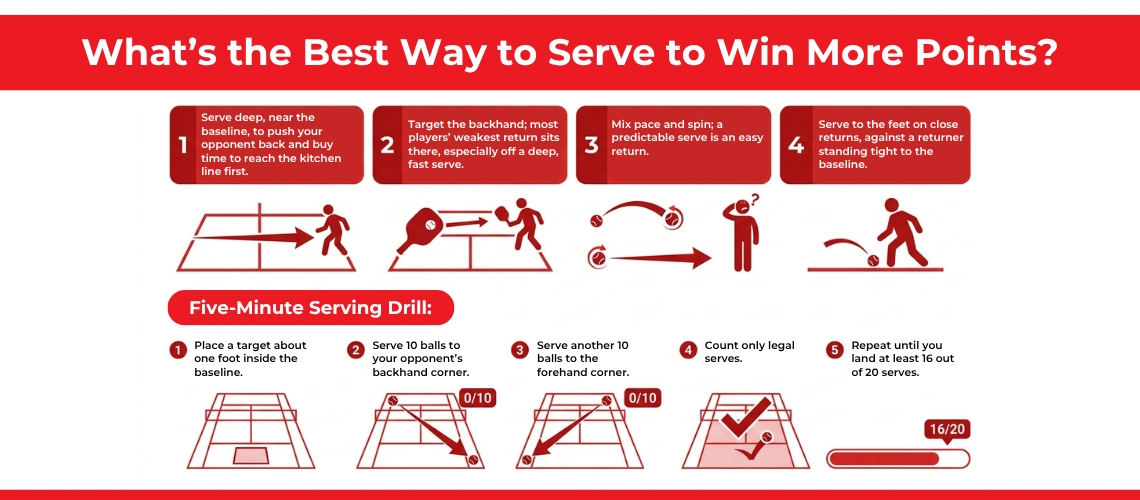
What’s the Best Way to Serve to Win More Points?
The best serve isn’t the hardest one; it’s the one that puts your opponent in an uncomfortable spot before the rally starts.
Game plans that hold up at every level:
- Serve deep, near the baseline, to push your opponent back and buy time to reach the kitchen line first.
- Target the backhand; most players’ weakest return sits there, especially off a deep, fast serve.
- Mix pace and spin; a predictable serve is an easy return.
- Serve to the feet on close returns, against a returner standing tight to the baseline.
Five-Minute Serving Drill
Improve your serve accuracy with this quick practice routine.
- Place a target about one foot inside the baseline.
- Serve 10 balls to your opponent’s backhand corner.
- Serve another 10 balls to the forehand corner.
- Count only legal serves.
- Repeat until you land at least 16 out of 20 serves.
Returning a fast serve uses the same setup in reverse: A step behind the baseline, a split-step timed to your opponent’s contact, and a shortened block instead of a full swing. Ball choice matters here too; a serve that wobbles off an uneven bounce is a serve that misses. MAX 5’s MX Pro Pickleballs use a 40-hole build calibrated for a consistent 30-34 inch bounce, so the serve you practice is the serve you get in a real rally.
What Are The Common Serving Mistakes Beginners Make?
Even experienced players develop bad serving habits.
Watch for these common mistakes:
- Standing on the baseline before making contact.
- Swinging too hard instead of serving deep.
- Forgetting the score and serving from the wrong side.
- Watching the paddle instead of the target.
- Trying heavy spin before mastering a legal serving motion.
Fixing these small mistakes often leads to more consistent serves and fewer free points for your opponent.
Conclusion:
A reliable serve gives you control before the rally even begins. Learn the official rules, practice consistent placement, and build confidence with both the volley and drop serve. Small improvements in serving technique can lead to more free points and fewer faults during every match.
When you’re ready to improve your game, quality equipment can make practice more consistent. Explore MAX5 paddles and pickleballs designed for players who want dependable performance on every serve. Follow MAX5 on Facebook and Instagram for gear drops and court tips.