
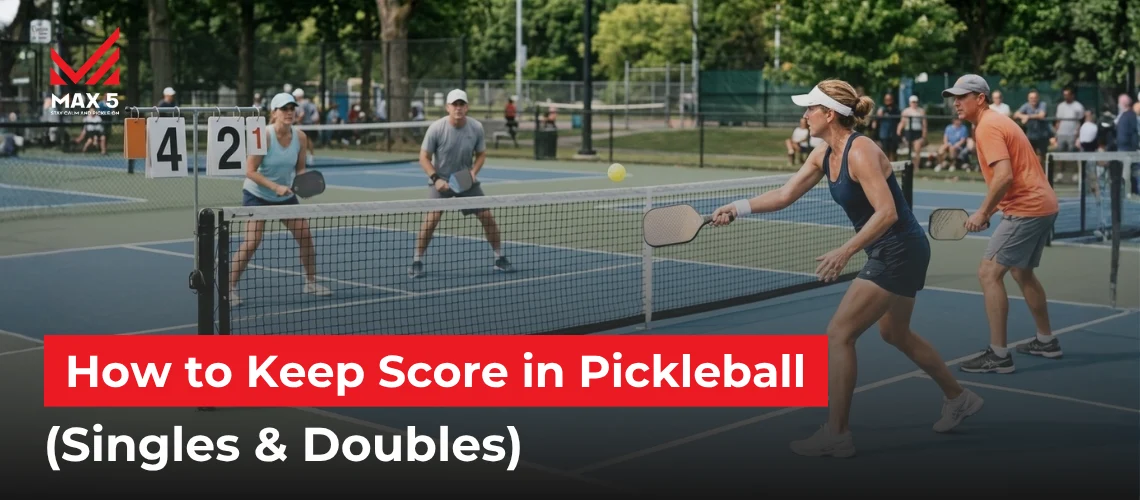
How to Keep Score in Pickleball (Singles & Doubles)
Someone calls out “4-2-1” mid-rally, and you freeze. Sound familiar? Pickleball scoring trips up more beginners than the kitchen (non-volley zone) rule ever will, and even regulars blank out on the occasional doubles side-out.
Here’s the good news: Once a few core rules click, keeping score becomes automatic. This guide covers exactly how to keep score in pickleball in singles and doubles, why that confusing “0-0-2” opening call exists, and the real difference between traditional and rally scoring, all based on the current USA Pickleball rulebook.
Grab your paddle. Time to play like you already know exactly what you’re doing, because by the end of this, you will.
How Do You Keep Score in Pickleball?
In the world of pickleball, the most important thing to remember is that only the serving side can score. Think of it like a “Power-Up”, you can only rack up points while you have the ball in your hand.
- Scoring a Point: You earn a point every time you win a rally as the server.
- The Side Out: If the receiving side wins the rally, they don’t get a point. Instead, they win the “Right to Serve.” This is called a Side Out.
- Winning Conditions: Most recreational games go to 11 points, but you must win by two. In high-stakes tournaments, you might play to 15 or 21.
Pro Tip: Using a high-visibility ball like the MX Pro Optic Green Pickleball makes it easier to track long rallies, so you don’t lose focus on the score when the game gets fast.
What Does 0-0-2 Mean in Pickleball?
“0-0-2” is how every doubles game kicks off. The score is 0-0, and the “2” means only the second server position gets to serve during that opening turn. It’s a built-in fairness rule, not a typo.
- Normally, both partners serve before a side out. At the very start of the game, only one gets that chance.
- This levels the playing field so the team serving first doesn’t get a free head start.
- The player on the right side serves first, and since they’ll be the only server before the side out, they’re counted as “server 2” from point one.
- After that opening turn, normal doubles rules take over for the rest of the match.
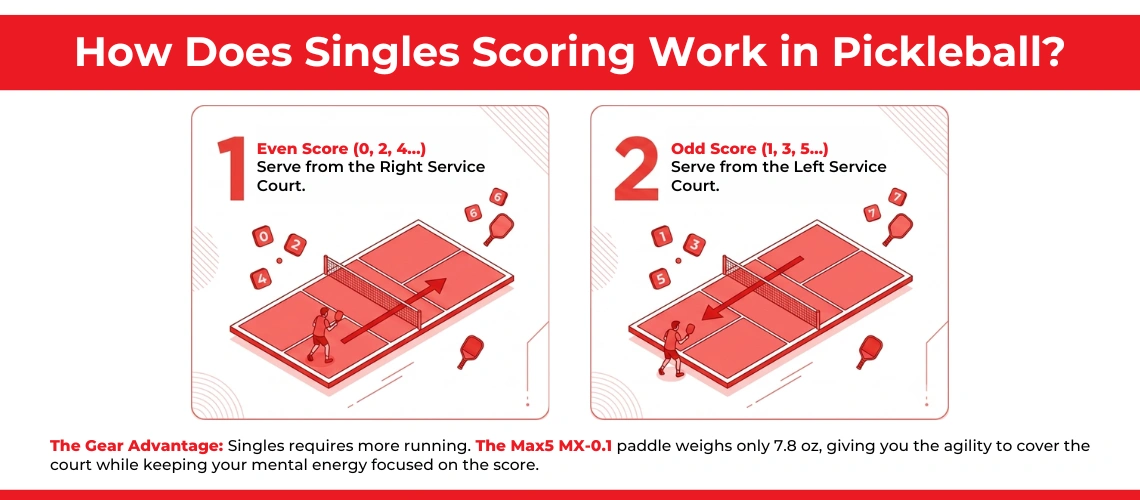
How Does Singles Scoring Work in Pickleball?
Singles scoring is a simplified “Duel Mode.” You don’t need to worry about a “Server Number” because there is no partner. The score is just two numbers: Your Score – Opponent’s Score.
The Even/Odd Rule: Your score tells you where to stand.
- Even Score (0, 2, 4…): Serve from the Right Service Court.
- Odd Score (1, 3, 5…): Serve from the Left Service Court.
The Gear Advantage: Singles requires more running. The Max5 MX-0.1 paddle weighs only 7.8 oz, giving you the agility to cover the court while keeping your mental energy focused on the score.
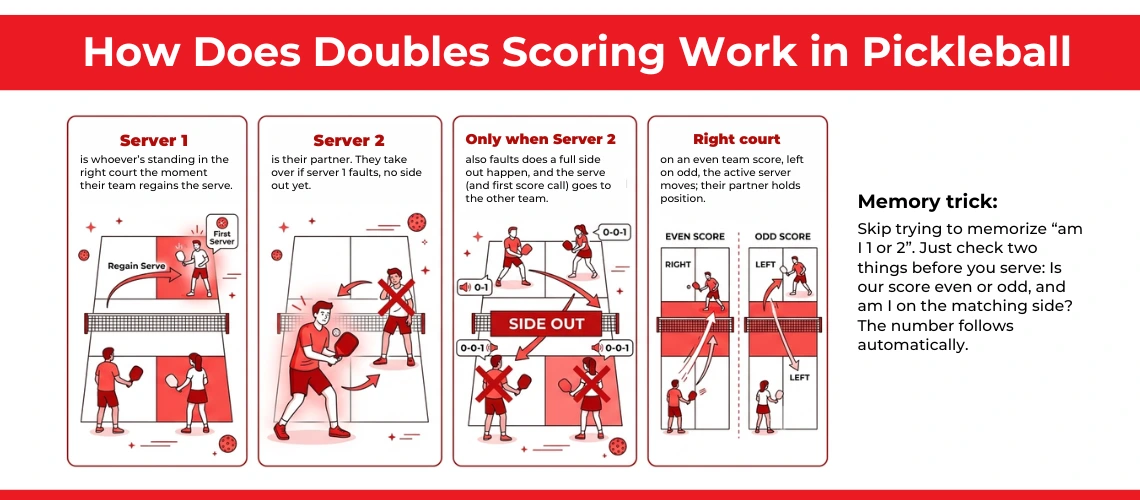
How Does Doubles Scoring Work in Pickleball?
Doubles scoring uses three numbers because two players share the serve: the serving team’s score, the receiving team’s score, and the server number (1 or 2) currently serving.
- Server 1 is whoever’s standing in the right court the moment their team regains the serve.
- Server 2 is their partner. They take over if server 1 faults, no side out yet.
- Only when Server 2 also faults does a full side out happen, and the serve (and first score call) goes to the other team.
- Right court on an even team score, left on odd, the active server moves; their partner holds position.
Memory trick: Skip trying to memorize “am I 1 or 2”. Just check two things before you serve: Is our score even or odd, and am I on the matching side? The number follows automatically.
Quick example: Your team wins a side our at 6-4. Whoever’s on the right becomes Server 1, and the score is called “6-4-1.” Win again? It’s 7-4-1, and that server moves left (7 is odd). Fault instead? Your partner steps in as Server 2, still “7-4-2” serving from whichever side the score demands.
Singles vs. Doubles Scoring at a Glance
|
Singles |
Doubles |
|
|
Numbers called |
2 (your score, opponent’s score) |
3 (serving score, receiving score server number) |
|
Who serves |
One player per side |
Two players share the serve, one at a time |
|
First side out of the game |
N/A |
Only Server 2 serves before the first side out (0-0-2) |
|
Court position |
Right on even score, left on odd |
Same rule, applied to whichever partner is serving |
|
When serve changes sides |
After any lost rally |
After both partners have faulted |
What Is a Side Out in Pickleball?
A Side Out is the “Reset Button” of pickleball. It happens when the serving team faults and the ball moves to the opponents.
In doubles, the sequence looks like this:
- Team A serves. Player 1 faults.
- Team A stays in place, and Player 2 serves.
- Player 2 faults. SIDE OUT.
- Team B now becomes the serving team.
Maintenance Tip:
During the break of a Side Out, take 5 seconds to check your paddle. Use a Max5 Pickleball Eraser to quickly wipe away ball residue. A clean T700 Carbon Fiber surface ensures your next serve has maximum spin and accuracy.
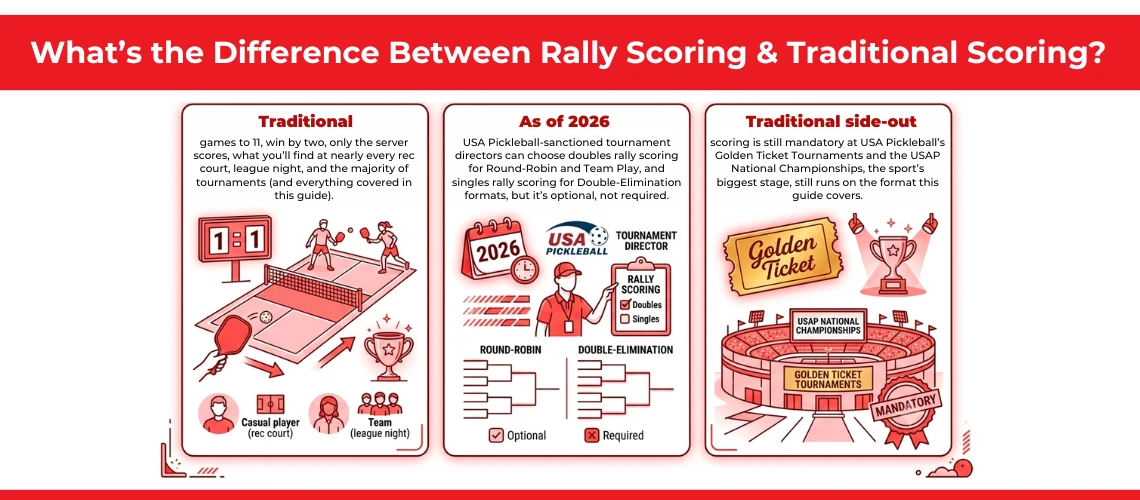
What’s the Difference Between Rally Scoring & Traditional Scoring?
Traditional (side-out) scoring only awards a point to the serving side. Rally scoring awards a point on every single rally, no matter who served. As of 2026, USA Pickleball lets tournament directors opt into rally scoring for certain sanctioned formats, but traditional scoring is still the standard almost everywhere else.
- Traditional: games to 11, win by two, only the server scores, what you’ll find at nearly every rec court, league night, and the majority of tournaments (and everything covered in this guide).
- As of 2026, USA Pickleball-sanctioned tournament directors can choose doubles rally scoring for Round-Robin and Team Play, and singles rally scoring for Double-Elimination formats, but it’s optional, not required.
- Traditional side-out scoring is still mandatory at USA Pickleball’s Golden Ticket Tournaments and the USAP National Championships, the sport’s biggest stage, still runs on the format this guide covers.
Playing in a tournament? Check the format sheet before your first match. Don’t assume it’s traditional scoring just because that’s the everyday norm. For the full format-by-format breakdown, read our guide on how many points you need to win.
How Many Points Do You Need to Win a Game of Pickleball?
Most recreational games go to 11 points, and you win by two. Tournament formats sometimes raise that to 15 or 21, still win by two, so it’s worth confirming the target score before the first serve.
- Casual and league play: race to 11, win by two, is the standard nearly everyone uses.
- Tournaments: Pool play is often to 11; medal or final rounds may switch to 15 or 21.
- Matches are typically best two-out-of-three games, so you may need to win twice to close it out.
- “Win by two” means an 11-10 lead isn’t enough play continues until someone’s ahead by two clear points.
- Lesser-known rule: if a wrong score gets called and nobody catches it until after the point is played, the rally still counts. You just correct the score before the next serve.
Conclusion:
Pickleball scoring sounds harder than it is. Only the serving side scores, doubles adds one number for the server, and the score gets called before every point. Play it a few times with your regular group, and it becomes as automatic as the game itself. Once scoring’s on autopilot, you can focus on what actually wins points, clean serves, solid dinks, and gear that doesn’t let you down mid-rally.
Max 5’s USA Pickleball-approved paddles and balls are built for exactly that level of focused play, from your first rec game to your first sanctioned tournament.
Got a scoring question this guide didn’t cover? Follow Max5 on Facebook and Instagram for more rules breakdowns and on-court tips. Game on.
Disclaimer:
The content provided by Max5 is for informational purposes only. Pickleball rules, including scoring & equipment standards, are maintained by the USA Pickleball Association (USAPA). While we provide high-quality, USAPA-compliant gear, players are responsible for staying updated on official rule changes. Max5 is not liable for any injuries or disputes resulting from the interpretation of these rules.