
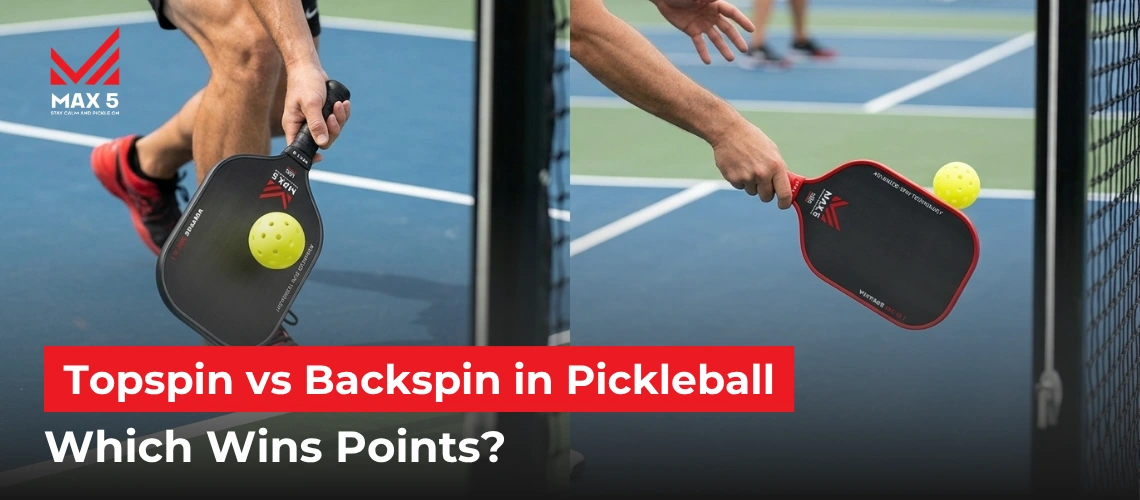
Topspin vs Backspin in Pickleball: Which Wins Points?
Topspin vs backspin in pickleball comes down to one question: Do you want the ball to attack, or do you want it to disappear? A topspin drive dives hard and kicks forward off the bounce. A backspin slice skids low and dies before your opponent can drive it back. Most new players lean on topspin because it feels powerful. Better players mix both, picking the spin that fits the moment: the drive, the reset, the dink, the serve.
Here’s how each spin works, when to use it, and which paddle surface actually grips the ball for more rotation.
What’s the Actual Difference Between Topspin and Backspin?
Topspin is forward rotation; the top of the ball rolls toward your opponent’s side. Backspin, sometimes called slice or underspin, spins the opposite way, with the bottom rolling toward the net. That difference changes the flight, the bounce, and how hard the shot is to handle.
- Topspin: paddle face closes slightly, the swing brushes up the back of the ball, and it dives down late before kicking forward off the bounce.
- Backspin: paddle face opens, the swing slides under the ball, and it skids low soon after landing.
- Paddle angle explains most of it. A closed, low-to-high path produces topspin; an open, flat or downward path produces backspin.
- Both spins work on a drive, a dink, a third shot, or a serve; spin changes how the ball behaves, not the shot type.
How Do You Hit a Clean Topspin Drive?
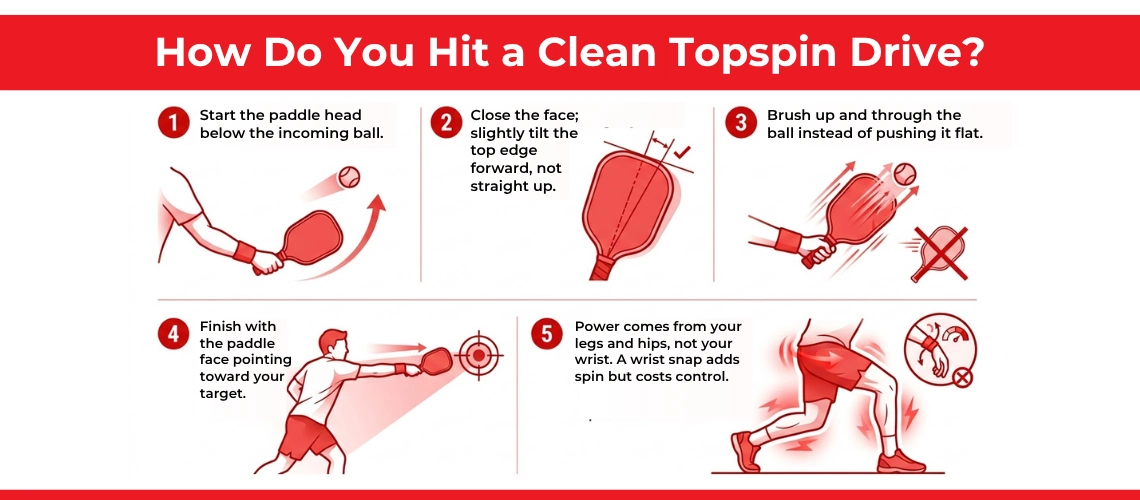
A topspin drive starts with a closed paddle face and a low-to-high swing path that brushes up the back of the ball at contact. The ball rockets over the net, dives late, and kicks forward once it lands, which pins your opponent deep or low.
- Start the paddle head below the incoming ball.
- Close the face; slightly tilt the top edge forward, not straight up.
- Brush up and through the ball instead of pushing it flat.
- Finish with the paddle face pointing toward your target.
- Power comes from your legs and hips, not your wrist. A wrist snap adds spin but costs control.
Topspin drives shine on the third shot: a passing shot down the line and a lob over a player camped at the net.
How Do You Hit a Controlled Backspin (Slice) Shot?
A backspin shot uses an open paddle face and a short, compact swing that slides under the ball at contact instead of brushing up it. The ball floats a beat longer in the air before it skids low off the bounce, leaving your opponent little to attack.
- Open the paddle face; tilt the top edge back toward you.
- Make contact low, near the bottom third of the ball, with a flat or slightly downward path.
- Keep the swing short; backspin comes from paddle angle, not a big arm motion.
- Stay soft in the hand for dinks and resets, firmer for a slice return of serve.
Reach for backspin on the third-shot drop, a reset from the baseline, or a slice return of serve to keep a fast server from teeing off on the following ball.
Which Spin Is Harder to Return: Topspin or Backspin?
Neither spin wins in every situation.
- Topspin gets tough to handle when it’s fast and deep.
- Backspin gets tough to attack when it’s low and short.
The real question isn’t which spin is stronger; it’s which spin fits the shot sitting in front of you.
- Topspin drives arrive fast and dip late, so a returner often makes contact too high on the paddle and pops the ball up.
- Backspin shots skid below net height, so a returner has to lift the ball just to clear the net, usually turning it into a weak, attackable ball.
- Offensive players lean on topspin to end points early.
- Defensive players and net specialists lean on backspin to slow the point down and draw an error.
Does Your Paddle Change How Much Spin You Can Put on the Ball?
Paddle surface texture changes how much the ball grips your face at contact; more grip means more rotation on the same swing. USA Pickleball caps how rough a hitting surface can be, so any spin edge between paddles comes from the material itself, not an illegal grit coating.
- Raw carbon fiber faces, like the weave on the MAX 5 Vintage MX-0.1 Carbon Fiber Pickleball Paddle, grip the ball longer than smoother composite faces
- That texture passes inspection because the grit is woven into the material, not added after manufacturing; sandpaper-style surfaces fail USA Pickleball’s equipment rules.
- Paddle weight changes feel and reaction time more than spin ceiling: lighter paddles whip through faster for quick dinks, heavier paddles carry more pace through drives
- On the serve, spin only counts if the paddle makes it at contact; pre-spinning the ball with your fingers first is a fault under current USA Pickleball rules.
- A dirty face kills spin fast, since oil and dust fill in the texture; within a few sessions, a quick wipe with the MX Pickleball Paddle Eraser keeps the grip fresh, no water or chemicals needed.
Conclusion:
Topspin and backspin aren’t rivals; they’re two tools for two different moments in a point. Reach for topspin to attack a short ball. Reach for backspin to slow the point down and draw a weak reply. The paddle in your hand plays a real part in how much rotation you can put on the ball, so a textured, tournament-legal face like MAX 5’s carbon fiber paddles gives you a head start on both shots.
Browse the full lineup in the MAX 5 shop and find the paddle that matches your game. Follow MAX 5 on Facebook and Instagram for more court tips.