
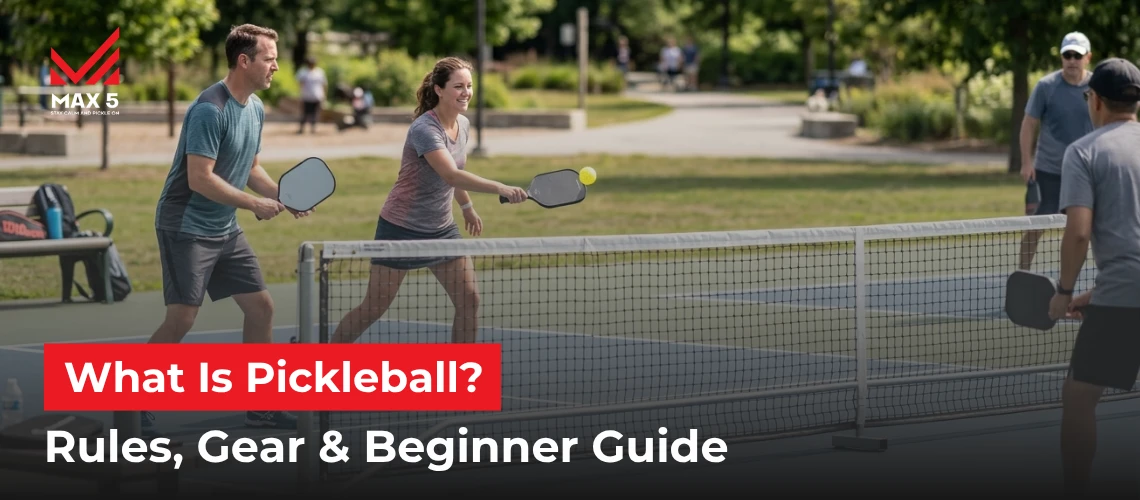
What Is Pickleball? Rules, Gear & Beginner Guide
You walk onto a court for open play, someone calls out “two-zero-two,” a serve clips the net and stays in play, and you’re left guessing what just happened. That confusion is the real pain point behind every search for what is pickleball: the game looks simple from the sidelines and feels chaotic the first time you’re holding a paddle.
This guide covers the actual rules, the terminology regulars use without explaining, the gear that genuinely matters, and why pickleball just became America’s fastest-growing sport for a fifth straight year.
What Is Pickleball, Exactly?
Pickleball is a paddle sport that combines elements of tennis, badminton, and table tennis. It was invented in the summer of 1965 on Bainbridge Island, Washington, by three dads: Joel Pritchard, Bill Bell, and Barney McCallum, who created the game to entertain their bored children using a badminton court, homemade paddles, and a perforated plastic ball. Today, it’s one of the fastest-growing sports in the United States.
- Court: 20 by 44 feet for both singles and doubles.
- Net: 36 inches at the posts, 34 inches at the center.
- Ball: A lightweight, perforated plastic ball similar to a wiffle ball.
- Paddle: Solid-faced, no strings, usually carbon fiber, graphite, or composite.
- Format: Singles (1v1) or doubles (2v2), the more common recreational format.
- Governed nationally by: USA Pickleball, which certifies paddles, balls, and courts for sanctioned play.
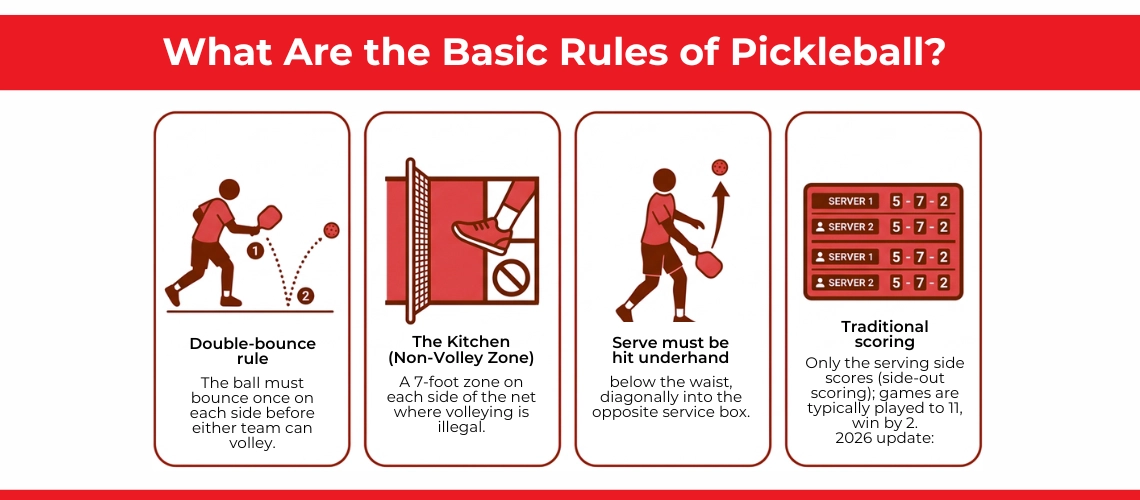
What Are the Basic Rules of Pickleball?
Every rally follows the same core structure:
- Double-bounce rule: The ball must bounce once on each side before either team can volley.
- The Kitchen (Non-Volley Zone): A 7-foot zone on each side of the net where volleying is illegal.
- Serve must be hit underhand, below the waist, diagonally into the opposite service box.
- Traditional scoring: Only the serving side scores (side-out scoring); games are typically played to 11, win by 2.
2026 update:
Many tournaments now offer optional rally scoring (a point on every rally), and either side can now close out game point, not just the server, after the old rule was eliminated this year.
Full rules live in the USA Pickleball Rulebook, worth a bookmark before your first tournament.
What Pickleball Terms Should Beginners Learn First?
Beginner confusion is rarely about rules; it’s about the vocabulary nobody explains.
Quick pickleball glossary:
Term | What It Means |
Dink | A soft, controlled shot dropped into the opponent’s kitchen |
Volley | Hitting the ball out of the air before it bounces |
Third Shot Drop | A soft arcing shot meant to land in the kitchen |
Reset | A defensive dink that slows down a fast exchange |
ATP | Around the Post, travels around the net post instead of over it |
Erne | Jumping outside the kitchen to volley near the net |
Ace | A serve that the opponent can’t return, winning the point outright |
Side Out | When the serve passes from one side to the other |
What Equipment Do You Need to Start Playing Pickleball?
A paddle, a sleeve of balls, and court shoes are genuinely enough to start, everything else is optimization.
- Paddle face material changes feel: T700 raw carbon fiber surfaces, like the one on the MAX 5 Vintage MX-0.1 Carbon Pickleball Paddle, grip the ball longer for more consistent spin than fiberglass.
- Core matters too: A 16mm polypropylene honeycomb core absorbs shock on dinks while still rebounding enough for drives.
- Look for the USA Pickleball Approved seal, which confirms surface roughness, deflection, and size limits, which matter the moment you enter a sanctioned match.
- Indoor vs. outdoor pickleballs aren’t interchangeable: outdoor balls, like MAX 5’s 40-hole optic green balls, are harder with smaller holes to resist wind; indoor balls are softer with fewer, larger holes.
- Court shoes with lateral support reduce ankle strain; running shoes aren’t built for side-to-side movement.
- A paddle eraser keeps a carbon face gripping the ball instead of sliding as grime builds up.
How Is Pickleball Different From Tennis?
- Court size: About a quarter of a tennis court.
- Equipment: A solid paddle replaces a strung racket, easing arm strain.
- Ball: A low-bounce perforated ball replaces a fuzzy one, slowing rallies down.
- Serve: Underhand only, versus tennis’s overhand serve.
- Learning curve: Most beginners rally within one session; tennis usually takes longer.
- Cost: A paddle and balls run far less than a racket, strings, and court fees.
Why Is Pickleball Growing So Fast in 2026?
Pickleball has been the nation’s fastest-growing sport for five consecutive years, with participation reaching 24.3 million Americans in 2025, up 22.8% year-over-year and 479% over five years.
- Most of that growth is casual play, not weekly competition. Don’t assume everyone on the court is a regular.
- Harvard Health links regular play to better cardiovascular health, strength, and bone density, plus measurable drops in stress.
Note:
Injury rates climb with age, with strains, sprains, and joint pain among the most common complaints. A proper warm-up and the right paddle weight matter as much as enthusiasm. Televised tours like the Professional Pickleball Association and Major League Pickleball have pulled the sport into mainstream media, recruiting new players who first saw it on TV.
How Do You Start Playing Pickleball as a Beginner?
Find local open play and learn the paddle stack: players lean paddles in a line against the fence and rotate onto open courts in order. Nobody explains this, and it’s the top reason beginners feel lost at their first session.
Get a skill rating: USA Pickleball’s 1.0-5.0 self-rating or the app-based DUPR rating shows your level. A 3.0 player can sustain a short rally but is still building consistency.
Join a ladder league to climb skill brackets at your own pace
Buy one solid paddle and a 3-pack or 6-pack of balls first, most beginners outgrow their paddle’s weight and grip, not its price tag
Conclusion:
Pickleball earns its growth: low cost of entry, a short learning curve, and a social doubles format that beats almost any sport for making fast friends. Start with a USA Pickleball-approved paddle, learn the kitchen and double-bounce rules, and show up to open play already knowing how the paddle stack works.
Ready to gear up? Shop MAX 5’s pickleball paddles and balls, built by players who wanted tournament-legal performance without the tournament price tag. Follow MAX5 on Facebook and Instagram for new gear drops and player tips.
Test: fuel christy knowings colt ford prichard colon steelers field of dreams game