
What Kind of Ball Is Used in Pickleball? Types & Specs 2026
You grabbed a paddle, found a court, and then someone asked, “Did you bring the right ball?”
Most players never think about this until inconsistent bounces, cracked balls, or a dead-feeling paddle forces the question. The ball you use directly affects your spin, shot control, bounce consistency, and even how long your paddle lasts. Getting it right from the start matters more than most beginners realize.
This guide covers exactly what pickleball balls are made of, how they are built, why indoor and outdoor balls behave differently, and what to look for before buying.
What Kind of Ball Is Used in Pickleball?
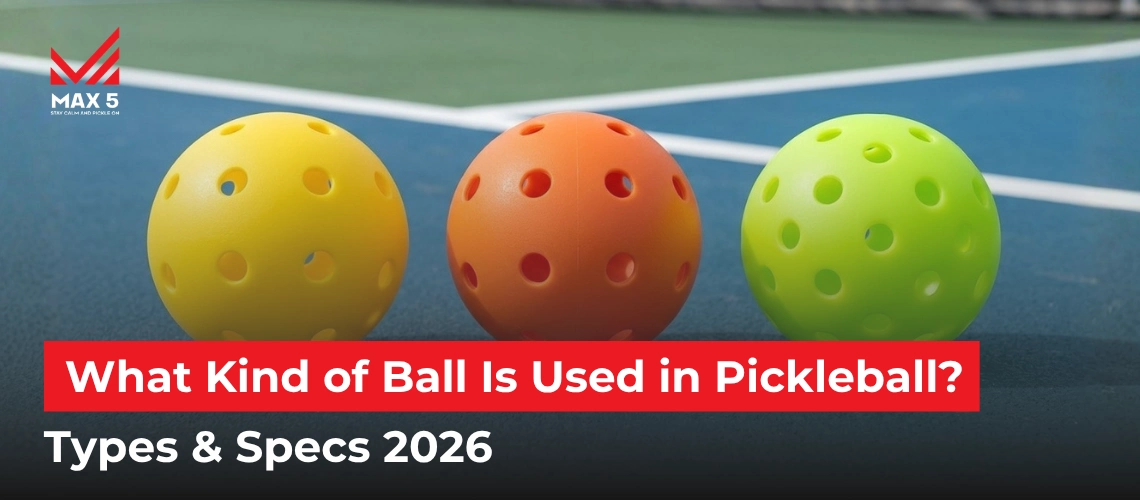
Pickleball uses a hard, hollow, perforated plastic ball made from rigid PE polymer, polyethylene, or a similar thermoplastic compound.
It has no rubber core, no foam fill, and no felt coating. The ball is completely hollow, and that hollowness combined with precision-drilled holes controls how it flies, bounces, and responds off your paddle face.
USA Pickleball (USAPA), the sport’s official governing body, sets strict standards every approved ball must meet:
- Diameter: 2.874 to 2.972 inches.
- Weight: 0.78 to 0.935 ounces.
- Bounce: 30 to 34 inches when dropped from 78 inches onto granite.
- Hardness: 40 to 50 on the Durometer D scale.
- Holes: 26 to 40 circular, evenly spaced holes.
- Surface: Smooth and non-textured.
- Markings: Manufacturer name and USAPA approval seal required.
Every ball used in sanctioned league or tournament play must hit all of these marks without exception.
How Is Pickleball Different From Wiffle Ball?
A wiffle ball has 8 oblong holes clustered on one side only, deliberately designed to wobble and curve unpredictably. It is engineered for backyard fun, not competitive play.
A regulation pickleball has 26-40 circular holes distributed symmetrically across its entire surface. That symmetry produces straight, stable, predictable flight on every shot. Each hole is precision-drilled at a beveled angle into the polymer shell to manage air drag, control speed, and stabilize trajectory.
The wall thickness is also uniform throughout, delivering the same consistent bounce whether you dink softly at the kitchen line or drive hard from the baseline.
They look similar from a distance. They perform completely differently. They are not interchangeable.
What Is the Difference Between Indoor Vs Outdoor Pickleballs?
This is where most players, even experienced ones, make costly mistakes. Both types use hard polymer construction within USAPA size and weight parameters. But their hole design, wall thickness, and hardness are built for entirely different environments.
Feature | Indoor Ball | Outdoor Ball |
Hole Count | 26 holes (typical) | 40 holes (typical) |
Hole Size | Larger, ~0.43 inches | Smaller, ~0.28 inches |
Construction | Softer, thinner walls | Harder, thicker walls |
Ball Speed | Slower, more controlled | Faster, firmer response |
Wind Resistance | Not needed indoors | High, small holes cut wind |
Best Surface | Gym floors, indoor courts | Asphalt, concrete, hard courts |
Indoor balls have larger holes, which creates more air resistance and naturally slows the ball. That drag makes soft shots, dinks, drops, and resets easier to learn and control. Beginners develop better touch mechanics starting indoors before moving to the faster outdoor game.
The MAX 5 MX Pro Pickleballs perform consistently across both surfaces, are one-piece seamless PE polymer, have 40 precision-drilled holes, bounce calibrated at 30-34 inches, fully USAPA compliant. Available in a 3-pack at $7.99 and a 6-pack at $11.99 at max5.us.
Why Does Seamless Construction Matter?
This single specification separates quality balls from cheap ones. A seamless pickleball is formed from one piece of rotationally molded polymer.
Cheaper balls are injection-molded in two pieces and bonded together. That seam becomes a structural weak point under repeated impact, especially on rough outdoor courts, producing early cracks, splits, and inconsistent deflection exactly where the halves meet.
One-piece seamless construction delivers:
- Uniform wall thickness across the entire surface.
- Consistent bounce from every contact angle.
- No seam-related failure points.
- Significantly longer lifespan on abrasive courts.
The MAX 5 MX Pro uses one-piece seamless construction, the same standard trusted for tournament-grade performance at every level of play.
Does the Ball You Use Affect Your Paddle?
Yes, and this connection is rarely discussed.
Every contact between a polymer ball and your paddle’s carbon fiber surface transfers microscopic residue, ball material, court dust, skin oils, and airborne grime. Over dozens of rallies, this builds up inside the micro-texture of your paddle face.
What this silently costs you:
- Reduced grip on the ball means less topspin and slice.
- Dinks feel flat and unresponsive.
- Your paddle feels dead even though it is physically undamaged.
How to Fix It in Under 1 Minute:
A dry-rub carbon fiber paddle eraser lifts residue instantly no water, no chemicals, no surface scratching. The MAX 5 MX Clean Paddle Eraser is purpose-built for T700 carbon fiber surfaces, restoring spin texture and grip response between every session.
This is also why ball quality affects paddle longevity directly. A smooth, seamless ball like the MAX 5 MX Pro is genuinely gentler on carbon fiber than rough, poorly finished balls acting as mild abrasives against your paddle face on every single shot.
How Do You Choose the Right Pickleball?
Stop grabbing whatever is cheapest. Here is a clear decision framework:
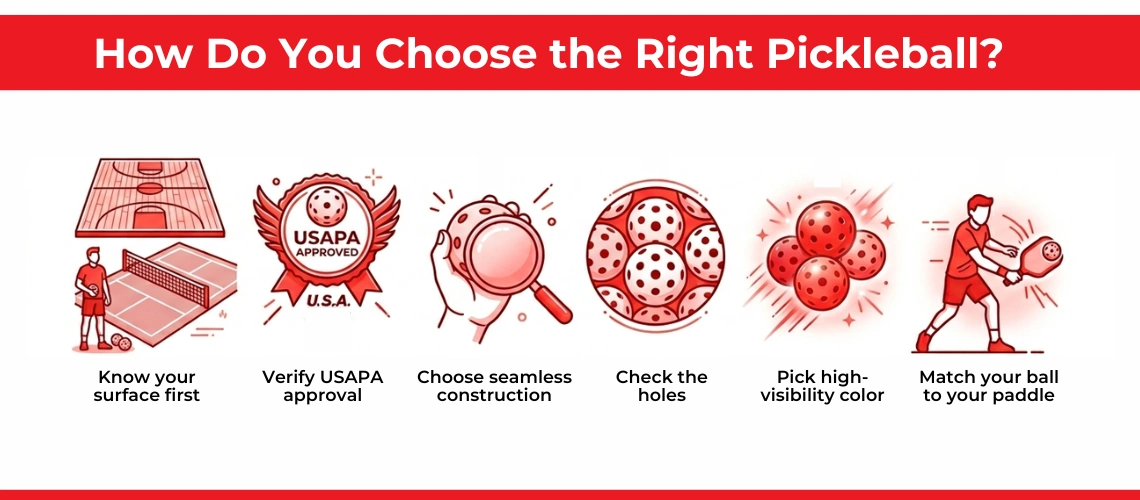
- Know your surface first: Outdoor asphalt or concrete requires a 40-hole hard ball. Indoor gym floors call for a 26-hole softer ball for better touch and control.
- Verify USAPA approval: For any league or tournament, the ball must display USAPA approval on the packaging, not just in a website description.
- Choose seamless construction: One-piece rotationally molded balls outlast two-piece injection-molded balls significantly, especially under repeated hard-court use.
- Check the holes: Hold the ball to light. Holes should be evenly spaced, cleanly drilled, and consistent in size. Uneven or rough holes cause mid-flight wobble and unpredictable bounce.
- Pick high-visibility color: Optic green and bright yellow improve visibility in sunlight, indoor lighting, and shaded outdoor courts.
- Match your ball to your paddle: If you play with a carbon fiber paddle like the MAX 5 Vintage MX-0.1, pair it with a smooth seamless ball. The T700 carbon surface grips a quality polymer shell for maximum natural spin, and a better ball preserves that surface texture longer.
Conclusion:
The ball you use in pickleball is not a minor detail. It shapes every rally, influences your skill development, and quietly affects how long your paddle performs.
A regulation pickleball is precision-engineered, calibrated to exact bounce standards, built from specific polymer compounds, and drilled with mathematical accuracy. Understanding what separates a quality ball from a poor one gives you a real advantage most players overlook entirely.
Explore the MAX 5 MX Pro Pickleball lineup at max5.us, USAPA-approved, seamlessly constructed, and built for players who take their game seriously. Follow MAX 5 on Facebook and Instagram for equipment insights and on-court tips.
Disclaimer:
This article is for general educational and informational use only. It is not a substitute for official rules, coaching, or equipment standards issued by USA Pickleball (USAPA). Pictures in this blog are created using AI tools.